La boutique est ouverte

Nous construisons les machines Workstation AI pour les sites web, les agents IA et l'entraînement de LLM — configurez-les et achetez-les en ligne.

Obtenir les prix pro
Produits IA
Labs IAAgents OpenAIAgents ClaudeGrok BotCRM natif Workstation AIMarketingTous les produits
Solutions IA
IA appliquéeAgents IAIA générativeAutomatisation par IAMontée en compétence IAOffres IA pour PMELaboratoire IA d'entrepriseStations de travail IAMatériel et logiciels NVIDIACalcul accéléré NVIDIAIA privéeCloud privé GPUClusters GPUIA en périphérieIA par secteur
Services IA
Modernisation des plateformesIngénierie numériqueFondations data et IAOpérations autonomesConseil IAAutomatisation DevOpsCybersécuritéDéveloppement logicielCréation d'agentsMise en place MLOpsLocation de GPUCloud privé GPU
À propos
EntrepriseNotre histoirePartenairesTémoignages clients
Centres de données IA
Centres de données IACloud privé GPUClusters GPULocation de GPU
Analyses IASérie JevLabo de benchmarksChoix de modèles
Notes techniques
Documentation
OS LinuxUbuntuRed Hat Enterprise LinuxSUSE LinuxAlpine LinuxDebian, Rocky & AlmaLinux
Plateformes cloud d'IAAWS & Amazon BedrockGoogle Cloud & Vertex AIMicrosoft Azure & AI FoundryClouds et places de marché GPU
Centres de données IA privésPour les cabinets d'avocatsPour les cabinets comptablesPlateformes sur siteCloud entièrement sécurisé
OutilsRing PromoterJobshout
Actualités
Blog
Nous contacterSe connecter

Stations de travail IA, logiciels multi-agents IA, infrastructure GPU et solutions d'agents intelligents pour les entreprises modernes.

Nous contacter

Solutions IA

IA appliquéeAgents IAIA générativeAutomatisation par IAMontée en compétence IAOffres IA pour PMELaboratoire IA d'entrepriseIA par secteur

Produits

Tous les produitsCRM & ERP natifs Workstation AIMarketingAgents OpenAIRing PromoterJobshout

Entreprise

À proposEntrepriseCentres de données IAPourquoi WorkstationPartenairesTémoignages clientsTarifsContactTenthMatrix

Ressources

Analyses IANotes techniquesDocumentationOS LinuxPlateformes cloud d'IACentres de données IA privésBlogRechercherPlan du site
Bureau de Belgique
Workstation SRL, Rue Vanderkindere 34, 1180 Uccle, BrusselsBE 0751.518.683Lun - Ven : 9h00 - 18h00 CET
+32 492 45 67 46
Siège social au Royaume-Uni
77-79 Marlowes, Hemel Hempstead HP1 1LFItinéraire : prenez la sortie 20 de la M25, Outer LondonN° d'entreprise: 11641870Lun - Ven : 9h00 - 18h00 GMT
+44 7515 356 146
Bureau de l'Inde
#159 Sector 9, Pocket 1, DDA Flats, 110077 Dwarka, New Delhi
+91 98881 98841
Bureau de Taïwan
3F, No. 2-4, Aisi Rd., Ren'ai Dist., Keelung City 200, Taiwan基隆市仁愛區愛四路2之4號3樓Lun - Ven : 9 h 00 - 18 h 00, heure de Taïwan (GMT+8)
+886 926 892 701+32 492 45 67 46
Bureau en Estonie
Aleksander Puškini tn 30-25, 20306 Narva, EstoniaLun - Ven : 9 h 00 - 18 h 00, heure d’Estonie (EET)
+32 492 45 67 46

© 2026 Workstation AI. Tous droits réservés.

ConfidentialitéSuppression des donnéesCookiesConditions d'utilisationPlan du site web

NVIDIA, le logo NVIDIA, RTX, RTX PRO, Blackwell, CUDA, NVLink, MGX, Omniverse, Spectrum-X, Quantum, BlueField, DGX et HGX sont des marques commerciales et/ou des marques déposées de NVIDIA Corporation aux États-Unis et dans d'autres pays. AMD, le logo AMD Arrow, EPYC, Instinct, Ryzen et Threadripper sont des marques commerciales d'Advanced Micro Devices, Inc. Dell et PowerEdge sont des marques commerciales de Dell Inc. ou de ses filiales. Intel et Xeon sont des marques commerciales d'Intel Corporation ou de ses filiales. AMAX, AceleMax et LiquidMax sont des marques commerciales d'AMAX Engineering Corporation. Tous les autres noms de produits, logos et marques appartiennent à leurs propriétaires respectifs. Nous les utilisons uniquement pour identifier les produits que nous décrivons, fournissons ou prenons en charge ; leur utilisation ne signifie pas que leurs propriétaires nous cautionnent.

Loading blog...

Accueil / Blogs
DevOpsSecuritySREKubernetesAIAutomation

WSL Proxy WAF: Explainable Web Application Firewall at the Edge

Live policies, stages and signatures on Workstation WSL Proxy — monitor or block, with support IDs on every decision

Balinder Walia16 septembre 20263 min read
Workstation WSL Proxy WAF — Web Application Firewall

Workstation WSL Proxy puts a governed Web Application Firewall on the same live-config edge that routes and caches your traffic. Policies bind per domain and route, run in monitor or block, and every decision names a support ID. Companion deep dive: long article. Product: /wsl-proxy.

Workstation WSL Proxy WAF — Web Application Firewall

Watch: WSL Proxy WAF tour

Workstation WSL Proxy WAF tour

Watch: youtu.be/r10XSonA5JE · Product: wslproxy.org · WAF: wslproxy.org/waf

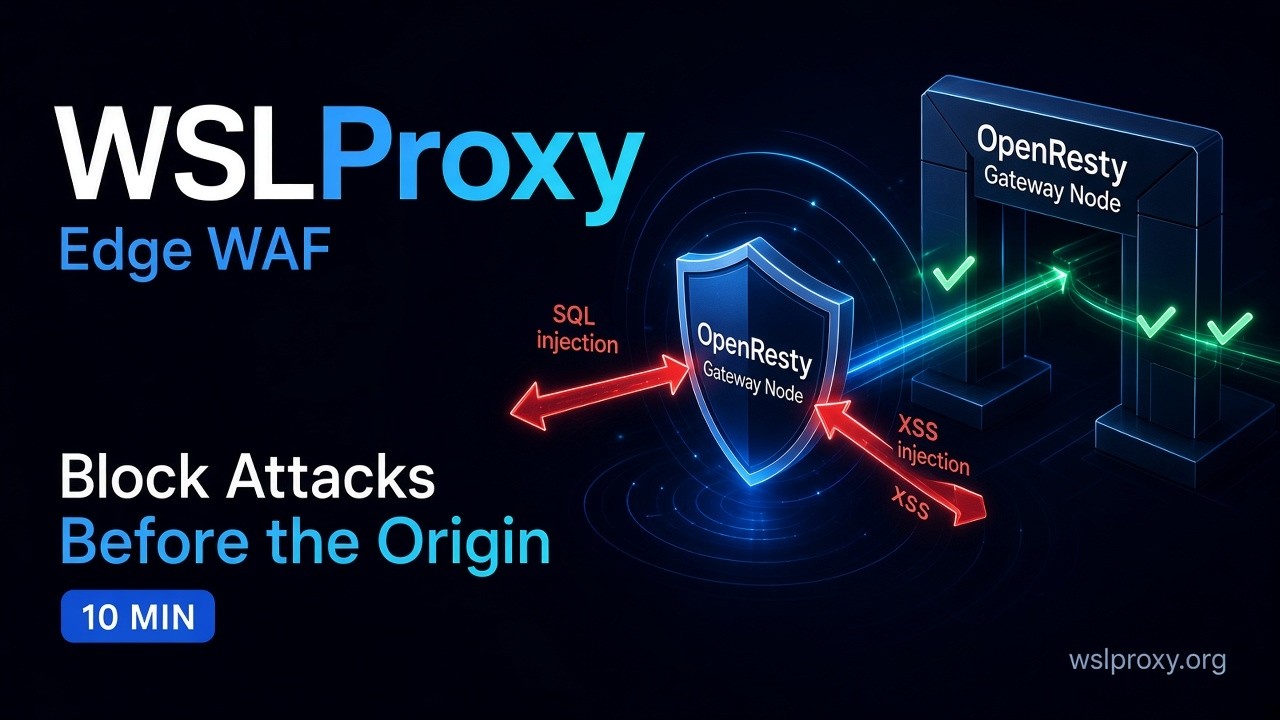
Bottom line. A WAF you cannot explain is a liability. Workstation WSL Proxy runs stages and governed signatures on the OpenResty request path after rate limiting, fails open by default so a WAF bug cannot take the site down, and returns X-WAF-* headers plus an X-Support-ID when it blocks.

The problem with opaque edge security

Most teams still protect APIs with a static nginx snippet, a shared ModSecurity pack nobody owns, or a cloud checkbox they cannot tune per route. When something breaks at 2 a.m., the ticket says “403 from the edge” with no policy name, no binding, and no safe way to dry-run a change. Reloading the whole POP for every rule change makes security and platform teams fight over the same config file.

Workstation WSL Proxy treats the edge as a product: live JSON and MCP configs for day-to-day routing and WAF, with nginx reloads reserved for listen and SSL changes. Security becomes operable — not a frozen regex list.

Where WAF sits in the pipeline

A request hits a POP. OpenResty accepts TLS and enters the Lua hot path. gateway_ack.lua matches a routing rule. The gateway pipeline then runs rate limits, then the WAF engine, then the response action and balancer. Typical outcomes include reverse-proxy to an upstream, redirect, static HTML, CAPTCHA challenge, or a 403 WAF block with support headers.

Inside the engine the order is fixed: load the policy, resolve the winning binding, run first-class stages, then governed signature matching and anomaly scoring. Each stage is fail-open under protected execution so an internal error logs and allows the request rather than blacking out the site.

What you get today

  • Policy packs bound per virtual host, with route and server overrides for monitor vs block.
  • Eight first-class stages before signatures: method allow-list, filetype deny, HTTP smuggling/desync, IP and geo deny, JWT algorithm policy, JSON depth/size, brute-force velocity, and OpenAPI positive security.
  • Governed signatures with stable IDs (SQLi, XSS, command injection, LFI, SSRF, SSTI, XXE, Log4Shell, Spring4Shell, JWT none, GraphQL introspection, scanner UAs, and related categories), plus disable / stage / set toggles and an anomaly threshold.
  • Explainable blocks: X-WAF-Block, X-WAF-Rule, X-WAF-Violation, X-Support-ID.
  • Layered edge controls on the same POP: per-server rate limit, CAPTCHA (rule status 306), JWT / S3 / cookie rule matches, and geo/IP routing rules independent of WAF stages.
  • Control plane: Admin UI, Swagger REST, MCP tools for Claude/Cursor, and wslproxy-cli pull/push for waf_rules and waf_policies.

Monitor first, then stage, then block

Binding precedence is deliberate: route override wins over per-server override, which wins over the policy default. That lets /preview stay in transparent (monitor/alarm) mode while /api/pay blocks. Signature stage windows alarm only until a timestamp and do not inflate the anomaly score — a safe rollout path before you flip a set to block.

Start in monitor on a staging POP or a low-risk path. Read structured wafsec logs and the events API. Promote sets when the noise is understood. Do not flip production to block without a soak.

Who it is for

Platform, SRE, and security teams who already run OpenResty or need an API gateway and CDN edge that security can actually operate. It is also for teams bringing AI agents to the same edge: MCP tools can already configure and inspect WSLProxy, while Agents Gateway and MCP Gateway integrations remain labelled in progress on the product page — not claimed as live WAF features.

Where to start

  1. Watch the tour above, then open wslproxy.org/waf.
  2. Read the technical article for stages, headers, and rollout practice.
  3. Explore the product overview at /wsl-proxy and the general intro at wslproxy.org.
  4. Engine deep dive: WAF Engine v2 blog · Engine v2 article.

Published by Workstation.

Product site: https://wslproxy.org · WAF: https://wslproxy.org/waf/