GPU Rentals: Pricing and Performance

GPU rentals give teams access to high-performance accelerators without buying hardware. For developers building workloads in manufacturing, retail, banking, education, HealthTech, FinTech and tax processing, the value proposition is the same: run compute-intensive work on demand and pay for the time you actually use. This article covers pricing, selection, trade-offs and operational practices for using rented GPUs in production.
Benefits of GPU Rentals
Renting removes capital risk and procurement delays. Teams can spin up an RTX 4090 or H100 for a training run, then release it when the job finishes. That elasticity matters for variable demand such as seasonal tax-return processing or retail demand forecasting.
Rentals also provide choice. You can match the GPU model to the workload instead of standardizing on one owned card. For regulated industries like banking and HealthTech, rentals can reduce on-premises data residency exposure by keeping sensitive training in a controlled cloud tenancy while still using rented compute.
The operational model is consistent across sectors: pay for usage, scale up for batch jobs, scale down to zero.
GPU Rental Pricing and Options
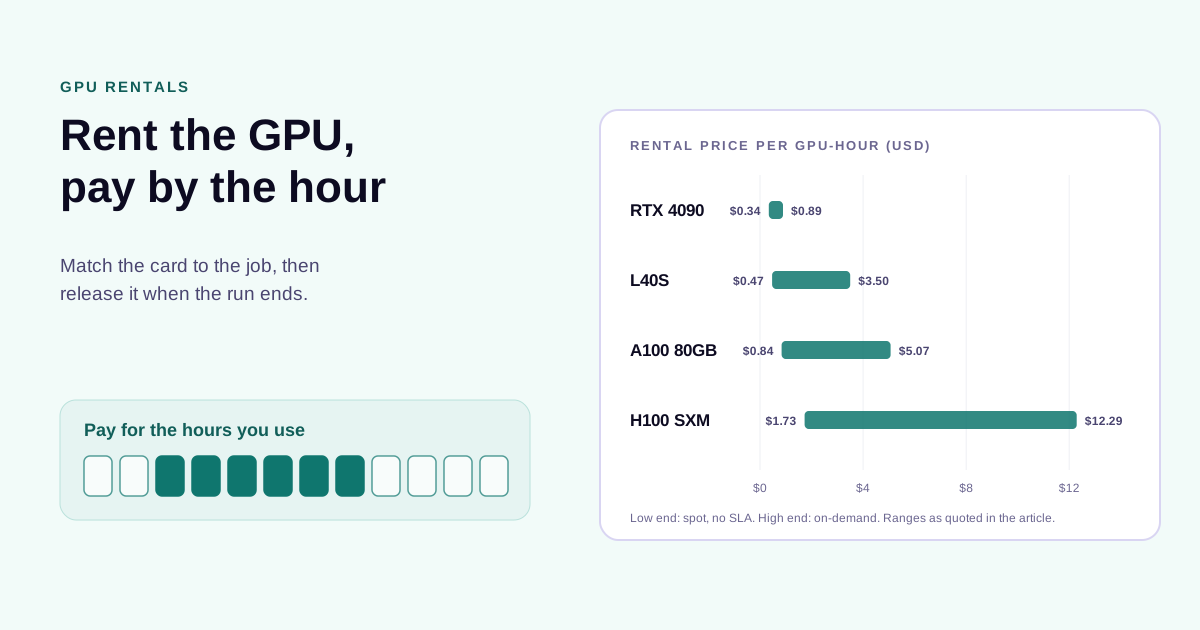
Pricing varies by GPU class and provider. Current market ranges from the sources tracked on Taipei Ledger show:
- RTX 4090 rental price ranges from $0.34 to $0.89 per hour [1]
- H100 SXM rental price ranges from $1.73 to $12.29 per hour [1]
- A100 80GB rental price ranges from $0.84 to $5.07 per hour [1]
- L40S rental price ranges from $0.47 to $3.50 per hour [1]
These ranges reflect spot vs on-demand pricing and region. The low end typically represents spot or preemptible offers with no SLA, suitable for bursty experiments with checkpointing. The high end represents on-demand pricing with availability guarantees, suitable for production SLAs.
Storage and networking are part of the option decision. One historical EC2 configuration described for large-scale analytics used six 500 GB General Purpose SSDs attached to the instance [2]. Those drives are setup in a RAID 0 configuration on each instance [2]. RAID 0 increases throughput at the cost of redundancy, a trade-off you must evaluate against data durability requirements in banking and HealthTech.
| GPU Model | Typical Rental Range | Typical Use Case |
|---|---|---|
| RTX 4090 | $0.34 – $0.89 / hour [1] | Prototyping, inference, small fine-tunes |
| A100 80GB | $0.84 – $5.07 / hour [1] | Training medium models, data science |
| L40S | $0.47 – $3.50 / hour [1] | Inference at scale, visualization |
| H100 SXM | $1.73 – $12.29 / hour [1] | Large model training, production AI |
A simple selection flow for a development workflow:
Example provisioning snippet for a rental via cloud provider CLI:
# Example: request a rental instance with GPU and attach storage
rental create --gpu RTX4090 --region us-east-1 --duration 4h --storage 500gb-ssd
rental attach --id $RENTAL_ID --raid 0
rental exec --id $RENTAL_ID --image nvidia/cuda:12.4-base
Challenges and Considerations
Cost predictability is the primary concern. Hourly ranges are wide; a run that stays up overnight can exceed budget. Unmonitored rentals create surprise spend.
Data movement and security matter. Moving training data to a rented GPU adds transfer time and compliance review. In HealthTech and banking, verify the provider’s isolation guarantees and data deletion policies.
Hardware heterogeneity complicates reproducibility. A model trained on an H100 may behave differently on an RTX 4090 due to memory and precision differences.
Rent vs own trade-off: Rentals win on burst and low fixed cost. Owned clusters win on latency, data locality and predictable marginal cost. NVIDIA DGX Spark is designed for AI developers, researchers, data scientists, and students who need powerful, always-on AI compute on the desktop [3]. It is a 170W device [4] with 128GB of LPDDR5X shared memory [4] available to both the GPU and the 20 CPU cores at the same time [5], strapped onto a 4TB NVMe SSD [5]. The system has up to 1 PFLOP of sparse FP4 tensor performance [6] and two QSFP ports driven by NVIDIA ConnectX-7 NIC capable of up to 200 Gbps [6] plus a 10 GbE RJ-45 Ethernet port [6].
DGX Spark can be used in a 2-node cluster configuration [4] and up to 4 DGX Spark systems can be connected using NVIDIA ConnectX-7 networking [3]. Two interconnected DGX Sparks can handle models with up to 405 billion parameters in FP4 [6]. DGX Spark ships with DGX OS and additional NVIDIA tools, including the NVIDIA NeMo framework for model fine-tuning and the NVIDIA RAPIDS libraries for accelerated data science [3].
These specs illustrate the trade-off between rented cloud GPUs and small-scale owned clusters.
Security and compliance for rentals require encryption at rest and in transit, assumption of multi-tenant hosts, and provider attestations. Avoid persisting PHI or PII on ephemeral disks.
Best Practices for Implementing GPU Rentals
Treat rentals as ephemeral. Automate provisioning and teardown with infra-as-code. Tag resources by project and owner so cost can be allocated to manufacturing lines, retail analytics, or tax processing teams.
Lock versions. Pin base images, CUDA, and container tags. NVIDIA has an official Docker container for the DGX Spark [5], which shows the value of vendor-supported images for reproducibility. Use the same discipline for rented GPUs.
Monitor utilization. Kill idle instances. Set max runtime and budget alerts. For batch jobs, use spot pricing with checkpointing.
Secure data. Encrypt data at rest and in transit. Assume the rented host is multi-tenant. For HealthTech and banking, prefer providers with attestations and avoid persisting PHI or PII on ephemeral disks.
Document performance baselines. Record throughput per GPU model so you can choose the cheapest adequate option. The price ranges above show that a 3x cost difference may not buy 3x performance for your workload.
Use vendor guides. NVIDIA now have extensive guides for getting things working on the Spark and they are a huge breath of fresh air [5]. While specific to DGX Spark, the principle applies: rely on official documentation for setup and tooling.
Production requirements include identity and access management for rental APIs, network isolation for data ingress/egress, and automated cost reporting per workload.
Case Studies and Examples
Manufacturing quality inspection: A plant uses rented L40S instances for overnight inference on camera feeds. The job runs 6 hours nightly during production weeks, then scales to zero. Rental pricing at $0.47 to $3.50 per hour [1] makes this cheaper than a 24/7 owned server.
Supermarket demand forecasting: Weekly retraining of a medium model on A100 80GB. Using the $0.84 to $5.07 per hour [1] range, a 4-hour run is predictable and fits the weekly planning cycle.
Banking fraud detection: Short-lived experiments on RTX 4090 for feature engineering. The $0.34 to $0.89 per hour [1] range enables many parallel trials without capital approval.
Education and research: A university lab uses DGX Spark units for always-on student access. DGX Spark ships with DGX OS and additional NVIDIA tools, including the NVIDIA NeMo framework for model fine-tuning and the NVIDIA RAPIDS libraries for accelerated data science [3]. This gives consistent tooling without cloud egress costs.
FinTech model validation: Two interconnected DGX Sparks can handle models with up to 405 billion parameters in FP4 [6], allowing local validation before promoting to rented H100s for final training. The H100 SXM rental price ranges from $1.73 to $12.29 per hour [1], so limiting large runs to validated configs saves money.
Tax returns processing: Seasonal spike handled by renting a pool of RTX 4090 nodes for 3 weeks. Automation tears them down after filing deadline, avoiding year-round ownership.
Across these examples, the decision pattern is the same: match workload duration and sensitivity to GPU class, automate lifecycle, and measure cost per useful output.
Conclusion
GPU rentals provide on-demand access to high-performance accelerators with clear cost ranges for RTX 4090, A100 80GB, L40S and H100 SXM. The main benefits are elasticity and choice, with challenges around cost predictability, security and reproducibility. Successful use requires automated provisioning, version pinning, monitoring and baselined performance. For always-on needs, owned options like NVIDIA DGX Spark offer desktop-class AI compute with 128GB shared memory and up to 1 PFLOP sparse FP4 performance, while rentals remain optimal for burst and seasonal workloads.
References
- GPU rental prices per hour: H100, B200, RTX 4090, updated daily · Taipei Ledger — taipeiledger.com
- 1.1 Billion Taxi Rides with BrytlytDB & 2 GPU-Powered p2.16xlarge EC2 Instances — tech.marksblogg.com
- NVIDIA DGX Spark: AI Supercomputer on Your Desk — nvidia.com (24 August 2025)
- The NVIDIA DGX Spark is a Tiny 128GB AI Mini PC Made for Scale-Out Clustering — servethehome.com (1 April 2025)
- NVIDIA DGX Spark: great hardware, early days for the ecosystem — simonwillison.net (15 October 2025)
- NVIDIA DGX Spark In-Depth Review: A New Standard for Local AI Inference - LMSYS Org — lmsys.org (14 October 2025)