Der Shop ist online

Wir bauen Workstation AI-Maschinen für Websites, KI-Agenten und LLM-Training – online konfigurieren und kaufen.

Händlerpreise erhalten
KI-Produkte
KI-LabsOpenAI-AgentenClaude-AgentenGrok-BotWorkstation AI-natives CRMMarketingAlle Produkte
KI-Lösungen
Angewandte KIKI-AgentenGenerative KIKI-AutomatisierungKI-WeiterbildungKI-Pakete für KMUEnterprise AI LabKI-WorkstationsNVIDIA-Hardware & -SoftwareNVIDIA Accelerated ComputingPrivate KIGPU-Private-CloudGPU-ClusterEdge-KIKI nach Branche
KI-Services
PlattformmodernisierungDigital EngineeringDatengrundlagen & KIAutonomer BetriebKI-BeratungDevOps-AutomatisierungCybersicherheitSoftwareentwicklungAgentenentwicklungMLOps-EinrichtungGPU-LeasingGPU-Private-Cloud
Über uns
UnternehmenUnsere GeschichtePartnerKundengeschichten
KI-Rechenzentren
KI-RechenzentrenGPU-Private-CloudGPU-ClusterGPU-Leasing
KI-EinblickeJev-ReiheBenchmark LabModellauswahl
Technische Hinweise
Dokumentation
Linux-BetriebssystemeUbuntuRed Hat Enterprise LinuxSUSE LinuxAlpine LinuxDebian, Rocky & AlmaLinux
KI-Cloud-PlattformenAWS & Amazon BedrockGoogle Cloud & Vertex AIMicrosoft Azure & AI FoundryGPU-Clouds & Marktplätze
Private KI-RechenzentrenFür AnwaltskanzleienFür Steuer- und WirtschaftsprüfungskanzleienOn-Premises-PlattformenVollständig abgesicherte Cloud
ToolsRing PromoterJobshout
News
Blog
KontaktAnmelden

KI-Workstations, Multi-Agenten-KI-Software, GPU-Infrastruktur und intelligente Agentenlösungen für moderne Unternehmen.

Kontakt

KI-Lösungen

Angewandte KIKI-AgentenGenerative KIKI-AutomatisierungKI-WeiterbildungKI-Pakete für KMUEnterprise AI LabKI nach Branche

Produkte

Alle ProdukteWorkstation AI-natives CRM & ERPMarketingOpenAI-AgentenRing PromoterJobshout

Unternehmen

Über unsUnternehmenKI-RechenzentrenWarum WorkstationPartnerKundengeschichtenPreiseKontaktTenthMatrix

Ressourcen

KI-EinblickeTechnische HinweiseDokumentationLinux-BetriebssystemeKI-Cloud-PlattformenPrivate KI-RechenzentrenBlogSucheSitemap
Büro Belgien
Workstation SRL, Rue Vanderkindere 34, 1180 Uccle, BrusselsBE 0751.518.683Mo – Fr: 9:00 – 18:00 Uhr MEZ
+32 492 45 67 46
Hauptsitz Großbritannien
77-79 Marlowes, Hemel Hempstead HP1 1LFAnfahrt – Ausfahrt 20 der M25 (Outer London)Handelsregisternr.: 11641870Mo – Fr: 9:00 – 18:00 Uhr GMT
+44 7515 356 146
Büro Indien
#159 Sector 9, Pocket 1, DDA Flats, 110077 Dwarka, New Delhi
+91 98881 98841
Büro Taiwan
3F, No. 2-4, Aisi Rd., Ren'ai Dist., Keelung City 200, Taiwan基隆市仁愛區愛四路2之4號3樓Mo – Fr: 9:00 – 18:00 Uhr Taiwan-Zeit (GMT+8)
+886 926 892 701+32 492 45 67 46
Büro Estland
Aleksander Puškini tn 30-25, 20306 Narva, EstoniaMo - Fr: 9:00 - 18:00 Uhr estnischer Zeit (EET)
+32 492 45 67 46

© 2026 Workstation AI. Alle Rechte vorbehalten.

DatenschutzDatenlöschungCookiesNutzungsbedingungenWebsite-Sitemap

NVIDIA, das NVIDIA-Logo, RTX, RTX PRO, Blackwell, CUDA, NVLink, MGX, Omniverse, Spectrum-X, Quantum, BlueField, DGX und HGX sind Marken und/oder eingetragene Marken der NVIDIA Corporation in den USA und anderen Ländern. AMD, das AMD-Arrow-Logo, EPYC, Instinct, Ryzen und Threadripper sind Marken von Advanced Micro Devices, Inc. Dell und PowerEdge sind Marken der Dell Inc. oder ihrer Tochtergesellschaften. Intel und Xeon sind Marken der Intel Corporation oder ihrer Tochtergesellschaften. AMAX, AceleMax und LiquidMax sind Marken der AMAX Engineering Corporation. Alle anderen Produktnamen, Logos und Marken sind Eigentum ihrer jeweiligen Inhaber. Wir verwenden sie ausschließlich, um die Produkte zu kennzeichnen, die wir beschreiben, liefern oder unterstützen; ihre Verwendung bedeutet nicht, dass ihre Inhaber uns empfehlen.

Startseite / Technische Hinweise / Technology
DevOpsCI/CDKubernetesSRE

Ring Promoter v1.0.2 — Rings, Orbit and Lanes Side by Side

Technical brief: Orbit Deployer Board, NEW Lanes matrix, Descent stage, ops polish since v1.0.1, and how the promotion protocol stays unchanged

25. September 2026Technology3 min read

Long-form companion to the v1.0.2 blog. Release notes and product context: Workstation Ring Promoter · ringpromoter.com · GitHub v1.0.2.
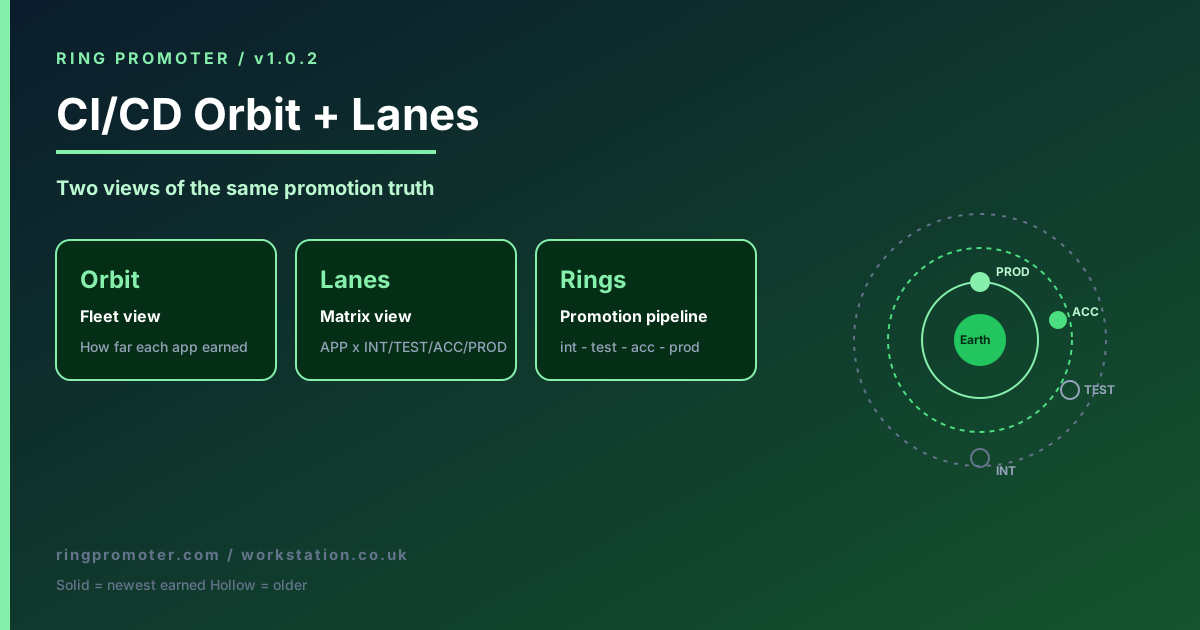
Ring Promoter v1.0.2 — Rings, Orbit and Lanes

youtu.be/hNU4sWxrDFk · Happy Friday release — 25 September 2026

Thesis. v1.0.2 does not change the promotion protocol — it gives operators two first-class views of the same truth: Orbit for the fleet, Lanes for the environment matrix. Rings remain the ordered pipeline; these UIs make “how far has this build earned?” obvious at a glance.
QA tests failing on a Friday? No worries. Ring Promoter will keep your applications healthy and auto-rollback if a promote lands unhealthy. When QA gates pass, auto-promote continues hop by hop all the way to Acceptance; production still waits for the human / password gate. See also: QA gates technical brief.

1. Ring Promoter v1.0.2 — what shipped

From the official release notes on GitHub and the “CI/CD Orbit and Lanes, side by side” section on ringpromoter.com:

Surface What you get
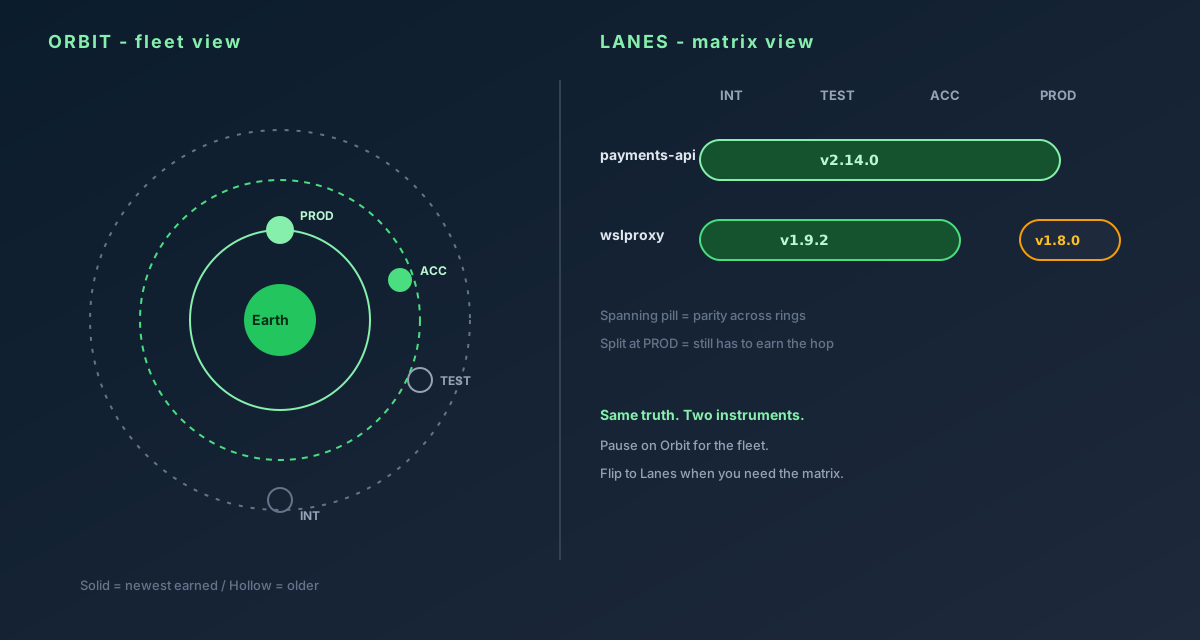
Orbit Deployer BoardEarth at centre as live users. Promotion rings are orbits — PROD closest in, then ACC, TEST, INT as outer spokes. Newest versions solid; older hollow. Gates and app roster ride alongside.
Lanes (NEW)APP × INT / TEST / ACC / PROD matrix. Same version across rings stretches as one pill. Prod lag is a visible break — no hunting per-app pages.
Descent and stageDescent treats rings as orbits (Lanes fallback). Cinematic Earth stage: more sky, quieter labels, collision-aware leaders.
Ops since v1.0.1In-place ring restart, external QA agent scaffolding, multi-arch images, longer Helm waits for cold pulls, clearer workstation secrets for production password gates.

2. Orbit vs Lanes — when to use which

Orbit beside Lanes

  • Orbit — pause here for the fleet: which apps climbed how far toward prod, with gates visible beside the stage.
  • Lanes — flip here for the matrix: parity across environments, or an obvious split when prod still has to earn the hop.

Both are companions to the walkthrough on ringpromoter.com — not a second source of truth. The control plane still enforces one ring at a time, source health, target health, auto-rollback, and history.

3. The protocol underneath (unchanged)

  1. One ring at a time — promote always targets the next ring; skipping is impossible by design.
  2. Source must prove it — live health on the source gates every hop.
  3. Target must earn it — health with retries after deploy.
  4. Failure undoes itself — unhealthy target rolls back automatically.
  5. Everything is written down — seed, promote, rollback in history per (app, ring).

Workstation product overview: /en/ring-promoter. Prior deep dives: modern CI/CD, QA gates, every release earns production.

4. Workstation angle

On Workstation instances, v1.0.2 makes multi-app release control rooms readable under load: Orbit for situational awareness, Lanes for “is prod behind?”, and the same YAML-onboarded apps, kubectl / GitHub Actions deployers, and production password gates operators already use.

5. Videos

  • This release: Rings, Orbit and Lanes (v1.0.2)
  • Quick intro: youtu.be/SjXwaTVuYhM · blog
  • QA gates: youtu.be/Vs2Em0HPvoY · blog

6. Links

  • Product site: https://www.ringpromoter.com/
  • Release notes: v1.0.2 on GitHub
  • Source: github.com/bwalia/ring-promoter
  • Workstation page: /en/ring-promoter

Published by Workstation.
Diesen Artikel teilen

Mehr zu Technology

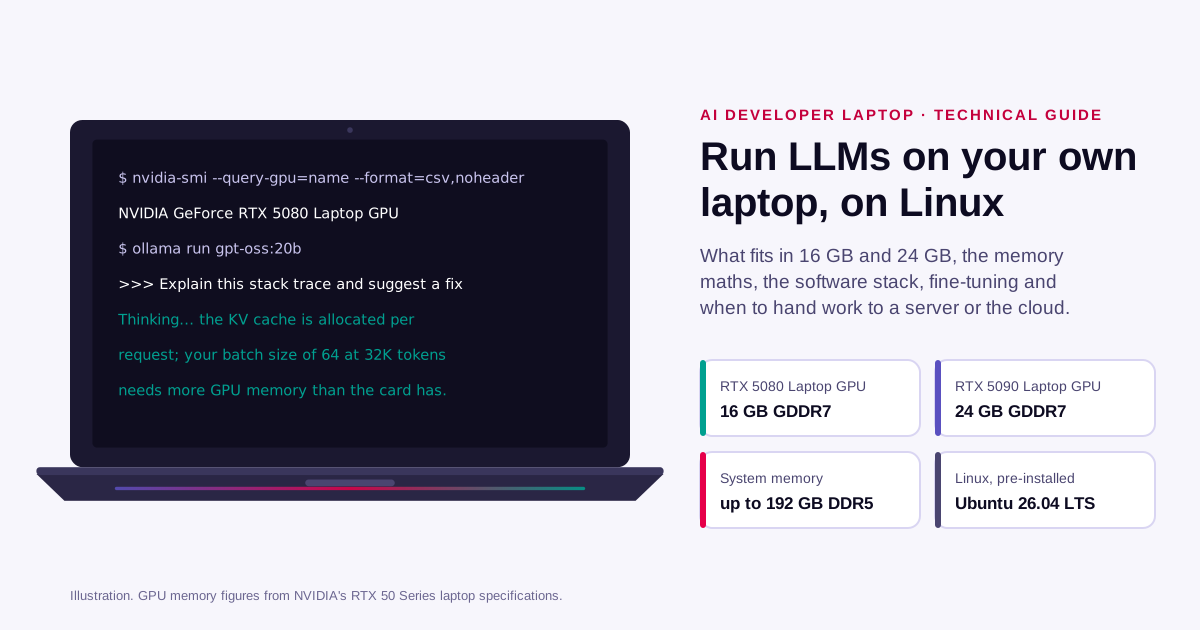
Laptops für KI-Entwickler: LLMs lokal unter Linux mit GPUs mit 16 GB und 24 GB betreiben (Leitfaden 2026)

Laptops für KI-Entwickler: LLMs lokal unter Linux mit GPUs mit 16 GB und 24 GB betreiben (Leitfaden 2026)

Was auf eine RTX 5080 oder RTX 5090 Laptop GPU passt, die Speicherrechnung, die lohnenden offenen Modelle, die Einrichtung von Ubuntu 26.04 mit dem NVIDIA-Stack, Ollama, llama.cpp und vLLM, Coding-Assistenten, LoRA-Fine-Tuning, Sicherheit und wann Arbeit auf einen Server gehört

Weiterlesen
ML- und LLM-Systeme testen, deren Korrektheit sich nicht beweisen lässt: ein Python-Evidenz-Kit

ML- und LLM-Systeme testen, deren Korrektheit sich nicht beweisen lässt: ein Python-Evidenz-Kit

Evidenz statt Beweise, in etwa 400 Zeilen Python mit echter Ausgabe: Slice-Metriken mit Bootstrap-Intervallen und einem Pass/Fail-Vertrag, Property- und metamorphe Tests mit Hypothesis, Kalibrierung und Conformal Prediction, Pydantic-Verträge und Regressionsevaluierungen für LLM-Ausgaben, Drift-Prüfungen, ein CI-Gate und die exakte Verifikation eines kleinen neuronalen Netzes

Weiterlesen
TorchCurves in der Praxis: lernbare B-Spline- und Legendre-Kurven in PyTorch

TorchCurves in der Praxis: lernbare B-Spline- und Legendre-Kurven in PyTorch

torchcurves installieren, eine Kurve anpassen und dimensionieren, B-Spline oder Legendre und die Eingabeabbildung wählen, eine monotone Kalibrierungskurve und ein additives Modell auf tabellarischen Daten bauen, mit SciPy, scikit-learn, einem KAN und einem MLP vergleichen, Koeffizienten nach JSON exportieren, testen und in der Produktion betreiben, mit echten Ausgaben

Weiterlesen