Der Shop ist online

Wir bauen Workstation AI-Maschinen für Websites, KI-Agenten und LLM-Training – online konfigurieren und kaufen.

Händlerpreise erhalten
KI-Produkte
KI-LabsOpenAI-AgentenClaude-AgentenGrok-BotWorkstation AI-natives CRMMarketingAlle Produkte
KI-Lösungen
Angewandte KIKI-AgentenGenerative KIKI-AutomatisierungKI-WeiterbildungKI-Pakete für KMUEnterprise AI LabKI-WorkstationsNVIDIA-Hardware & -SoftwareNVIDIA Accelerated ComputingPrivate KIGPU-Private-CloudGPU-ClusterEdge-KIKI nach Branche
KI-Services
PlattformmodernisierungDigital EngineeringDatengrundlagen & KIAutonomer BetriebKI-BeratungDevOps-AutomatisierungCybersicherheitSoftwareentwicklungAgentenentwicklungMLOps-EinrichtungGPU-LeasingGPU-Private-Cloud
Über uns
UnternehmenUnsere GeschichtePartnerKundengeschichten
KI-Rechenzentren
KI-RechenzentrenGPU-Private-CloudGPU-ClusterGPU-Leasing
KI-EinblickeJev-ReiheBenchmark LabModellauswahl
Technische Hinweise
Dokumentation
Linux-BetriebssystemeUbuntuRed Hat Enterprise LinuxSUSE LinuxAlpine LinuxDebian, Rocky & AlmaLinux
KI-Cloud-PlattformenAWS & Amazon BedrockGoogle Cloud & Vertex AIMicrosoft Azure & AI FoundryGPU-Clouds & Marktplätze
Private KI-RechenzentrenFür AnwaltskanzleienFür Steuer- und WirtschaftsprüfungskanzleienOn-Premises-PlattformenVollständig abgesicherte Cloud
ToolsRing PromoterJobshout
News
Blog
KontaktAnmelden

KI-Workstations, Multi-Agenten-KI-Software, GPU-Infrastruktur und intelligente Agentenlösungen für moderne Unternehmen.

Kontakt

KI-Lösungen

Angewandte KIKI-AgentenGenerative KIKI-AutomatisierungKI-WeiterbildungKI-Pakete für KMUEnterprise AI LabKI nach Branche

Produkte

Alle ProdukteWorkstation AI-natives CRM & ERPMarketingOpenAI-AgentenRing PromoterJobshout

Unternehmen

Über unsUnternehmenKI-RechenzentrenWarum WorkstationPartnerKundengeschichtenPreiseKontaktTenthMatrix

Ressourcen

KI-EinblickeTechnische HinweiseDokumentationLinux-BetriebssystemeKI-Cloud-PlattformenPrivate KI-RechenzentrenBlogSucheSitemap
Büro Belgien
Workstation SRL, Rue Vanderkindere 34, 1180 Uccle, BrusselsBE 0751.518.683Mo – Fr: 9:00 – 18:00 Uhr MEZ
+32 492 45 67 46
Hauptsitz Großbritannien
77-79 Marlowes, Hemel Hempstead HP1 1LFAnfahrt – Ausfahrt 20 der M25 (Outer London)Handelsregisternr.: 11641870Mo – Fr: 9:00 – 18:00 Uhr GMT
+44 7515 356 146
Büro Indien
#159 Sector 9, Pocket 1, DDA Flats, 110077 Dwarka, New Delhi
+91 98881 98841
Büro Taiwan
3F, No. 2-4, Aisi Rd., Ren'ai Dist., Keelung City 200, Taiwan基隆市仁愛區愛四路2之4號3樓Mo – Fr: 9:00 – 18:00 Uhr Taiwan-Zeit (GMT+8)
+886 926 892 701+32 492 45 67 46
Büro Estland
Aleksander Puškini tn 30-25, 20306 Narva, EstoniaMo - Fr: 9:00 - 18:00 Uhr estnischer Zeit (EET)
+32 492 45 67 46

© 2026 Workstation AI. Alle Rechte vorbehalten.

DatenschutzDatenlöschungCookiesNutzungsbedingungenWebsite-Sitemap

NVIDIA, das NVIDIA-Logo, RTX, RTX PRO, Blackwell, CUDA, NVLink, MGX, Omniverse, Spectrum-X, Quantum, BlueField, DGX und HGX sind Marken und/oder eingetragene Marken der NVIDIA Corporation in den USA und anderen Ländern. AMD, das AMD-Arrow-Logo, EPYC, Instinct, Ryzen und Threadripper sind Marken von Advanced Micro Devices, Inc. Dell und PowerEdge sind Marken der Dell Inc. oder ihrer Tochtergesellschaften. Intel und Xeon sind Marken der Intel Corporation oder ihrer Tochtergesellschaften. AMAX, AceleMax und LiquidMax sind Marken der AMAX Engineering Corporation. Alle anderen Produktnamen, Logos und Marken sind Eigentum ihrer jeweiligen Inhaber. Wir verwenden sie ausschließlich, um die Produkte zu kennzeichnen, die wir beschreiben, liefern oder unterstützen; ihre Verwendung bedeutet nicht, dass ihre Inhaber uns empfehlen.

Loading blog...

Startseite / Blogs
MysqlNode.jsBackend

Securing APIs in Node.js & MySQL Projects: Best Practices & Code Examples

Best Practices for API Security in Node.js & MySQL

Balinder Walia27. Mai 20253 min read
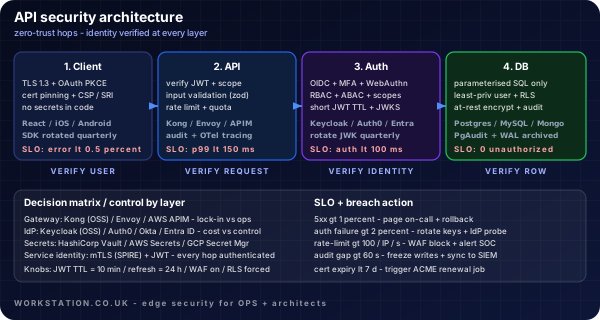
Api security diagram

Securing APIs in Node.js & MySQL Projects

API Security LayersClientBrowser/AppTLSHTTPS1.3🔒RateLimiterDDoSProtection🛡️AuthJWTVerifyRBAC🔑InputValidationSanitizeJoi/Zod✅SQLParamPreparedStatements🗃️MySQLDatabaseDefense in Depth: Each layer prevents a class of attacksNo single layer is sufficient — security requires all layers working togetherLayer 1Layer 2Layer 3Layer 4Layer 5Encryptsall trafficBlocks bruteforce attacksVerifiesidentityPreventsXSS / injectPreventsSQL injection
API Security Diagram

APIs are the backbone of modern web and mobile applications. When building APIs with Node.js and MySQL, security must be a top priority. This guide covers essential best practices and code examples to help you secure your APIs.

API Security Architecture
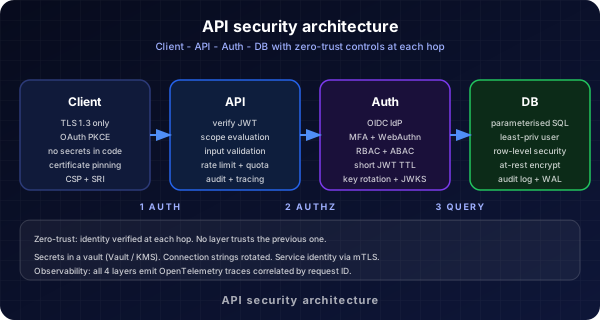
API Security Architecture

This diagram shows a layered approach to API security, including gateway, WAF, authentication, and database protection.

API Gateway & WAF
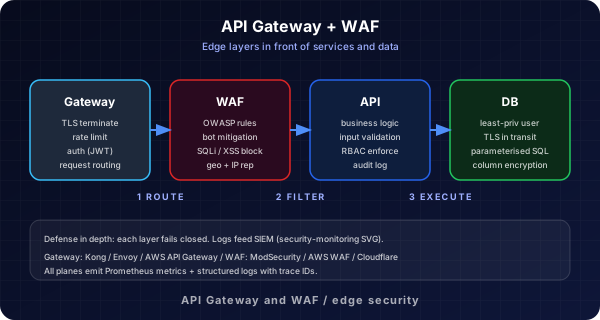
API Gateway and WAF

Use an API Gateway and Web Application Firewall (WAF) to centralize security, rate limiting, and request validation. This helps block malicious traffic before it reaches your Node.js app.

User to DB Flow
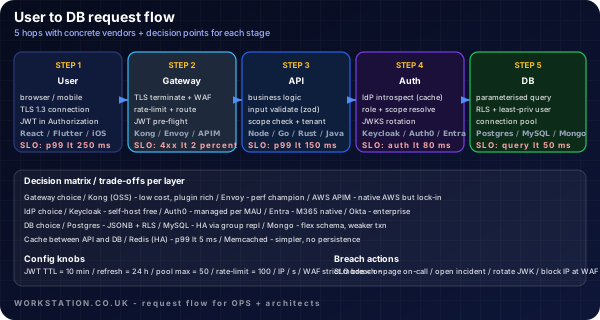
User to DB Flow

This diagram shows the secure flow from user to database, with authentication and authorization checks at each step.

1. Use HTTPS Everywhere

Always serve your API over HTTPS to encrypt data in transit. Use letsencrypt or a commercial SSL certificate.

2. Authentication & Authorization

  • JWT (JSON Web Tokens): Use JWT for stateless authentication. Issue tokens on login and verify them on each request.
  • Role-based Access Control (RBAC): Restrict access to sensitive endpoints based on user roles.
// Example: JWT middleware
const jwt = require('jsonwebtoken');
function authenticateToken(req, res, next) {
  const token = req.headers['authorization']?.split(' ')[1];
  if (!token) return res.sendStatus(401);
  jwt.verify(token, process.env.JWT_SECRET, (err, user) => {
    if (err) return res.sendStatus(403);
    req.user = user;
    next();
  });
}

3. Prevent SQL Injection

OWASP Top Threats & DefensesSQL InjectionMalicious queriesParameterized QueriesPrepared Statements & ORMBroken AuthWeak credentialsJWT + MFA + bcryptToken rotation & hashingXSSScript injectionInput SanitizationCSP headers & escapingSSRFInternal accessURL AllowlistNetwork segmentationMisconfigurationDefault settingsSecurity HardeningHelmet.js & auditEvery threat has a defense — implement all layers for complete protectionBased on OWASP Top 10 Web Application Security Risks

Always use parameterized queries or ORM libraries (like Sequelize or Knex) to prevent SQL injection.

// Using mysql2 with placeholders
const [rows] = await db.execute('SELECT * FROM users WHERE id = ?', [userId]);

4. Input Validation & Sanitization

Validate and sanitize all incoming data using libraries like express-validator or joi.

5. Secure Sensitive Data

  • Never store plain-text passwords. Always hash with bcrypt.
  • Store secrets (DB credentials, JWT secrets) in environment variables, not in code.

6. Rate Limiting & Throttling

Protect your API from brute-force and DDoS attacks using rate limiting middleware like express-rate-limit.

7. Logging & Monitoring

Log all authentication attempts and errors. Use monitoring tools to detect suspicious activity.

8. Keep Dependencies Updated

Regularly update Node.js, MySQL, and all dependencies to patch known vulnerabilities.

Further Reading

  • OWASP REST Security Cheat Sheet
  • Express.js Security Best Practices
Related reading. For an explainable edge Web Application Firewall on Workstation WSL Proxy, see the WAF blog, the technical article, or wslproxy.org.