DGX Spark: Scalable AI Compute

Introduction to DGX Spark
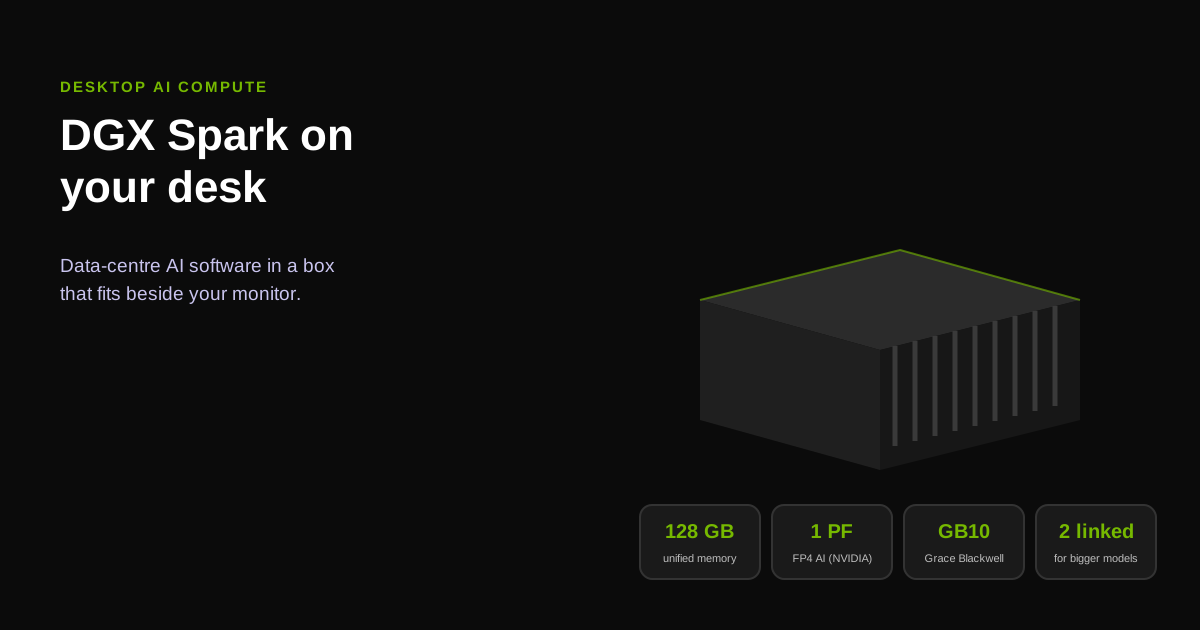
NVIDIA DGX Spark is positioned as a desktop-class AI workstation for organizations that need powerful, always-on AI compute without routing every workload to the cloud or a data center. It is designed for AI developers, researchers, data scientists, and students who need powerful, always-on AI compute on the desktop [1].
The system is built around a full-metal chassis with a sleek champagne-gold finish [2] and is packaged as a compact 170W device [3]. Hardware connectivity is explicit: four USB-C ports, one of which supports up to 240 W of power delivery [2], a 10 GbE RJ-45 Ethernet port [2], and two QSFP ports driven by NVIDIA ConnectX-7 NIC capable of up to 200 Gbps [2].
For the sectors you operate in — Manufacturing, Supermarkets, Banking, Education, HealthTech, FinTech and Tax Returns — the desktop nature matters. It allows a local pilot to run on the factory floor, in a branch back office, or in a university lab without waiting for data-center capacity or exposing sensitive customer, patient, or financial data to an external network for every experiment.
Applications in AI and Deep Learning
The Spark is designed for both training and running models [4]. The hardware is 20 Arm cores connected using C2C to a Blackwell generation GPU [3] with 128GB of LPDDR5X memory [3]. The DGX Spark has 128GB of memory that’s available to both the GPU and the 20 CPU cores at the same time [4].
That unified memory model changes how models can be iterated in regulated or data-sensitive environments. In HealthTech and Banking, for example, a model can be trained on-premise on de-identified data and then served locally for inference, reducing data transfer risk. In Manufacturing, a vision model for defect detection can be trained on the line and deployed on the same box. In Supermarkets and Tax Returns, retail demand forecasting or document classification can run continuously on the desktop without cloud egress costs.
Supported workloads include models such as gpt-oss, gemma3, llama3.1, and deepseek-r1 [5].
DGX Spark variants
| Feature | DGX Spark 64 GB | DGX Spark 128 GB |
|---|---|---|
| Target memory | 64 GB LPDDR5X | 128 GB LPDDR5X |
| Shared GPU/CPU memory | Yes | Yes, 128GB available to both GPU and 20 CPU cores [4] |
| Enterprise manageability | Available via feature port | Enterprise manageability features developed for 128 GB can also be applied to 64 GB [1] |
| Use case fit | Light prototyping, inference | Training and larger context models |
The choice is a trade-off between model size and data volume you can keep local. For FinTech fraud detection or HealthTech imaging, the 128 GB variant is typically needed to hold larger batches in memory.
Getting Started with DGX Spark
Getting started follows a short, repeatable process. The hardware is Ubuntu-based and NVIDIA provides an official Docker container for the DGX Spark [4].
A practical first-run looks like:
# Pull the official container
docker pull nvcr.io/nvidia/dgx-spark:latest

# Verify container runtime is available before running workloads
docker images | grep dgx-spark
Firmware maintenance is explicit. If you want to upgrade via the CLI, you will need to upgrade both the Ubuntu distribution as well as the firmware [5]. Plan upgrades during maintenance windows, especially in Banking and HealthTech where uptime and auditability are required.
Scalability and Connectivity
DGX Spark is designed to scale out. Up to 4 DGX Spark systems can be connected using NVIDIA ConnectX-7 networking [1]. Each unit provides two QSFP ports driven by NVIDIA ConnectX-7 NIC capable of up to 200 Gbps [2].
Scaling to four units is achieved by connecting units via the dual QSFP ports using NVIDIA ConnectX-7 networking. The NIC is documented as supporting 200GbE clustering with a second unit [3], and the product can be clustered up to four systems total [1]. This allows a small team in Education to start with one desktop for research, then add units for a departmental cluster, or for Manufacturing to co-locate multiple units near production lines for distributed inference.
The architecture is intentionally simple:
This is not a replacement for a large DGX rack, but it provides a path to modest parallelism without data-center re-architecture.
Deployment considerations by sector
- Manufacturing: Keep vision and predictive maintenance models local to avoid latency to the line. The 170W power envelope [3] fits edge cabinets. Scale out up to four units [1] for parallel line inference.
- Supermarkets / Retail: Use on-premise inference for checkout fraud and inventory forecasting while keeping customer transaction data inside the store network. Connect units via ConnectX-7 for regional model aggregation.
- Banking / FinTech / Tax Returns: Local training and inference supports data residency and audit requirements. The enterprise manageability features developed for DGX Spark 128 GB can also be applied to DGX Spark 64 GB [1].
- Education / HealthTech: Students and researchers get always-on access without cloud quotas, and clinical data can remain on-premise. Start with one unit and expand to a four-node cluster as course enrollment grows [1].
Conclusion
DGX Spark brings AI developer-class hardware to the desktop with a clear scalability path. It is designed for both training and running models [4] on a 128 GB memory pool with 128GB available to both GPU and 20 CPU cores at the same time [4], with enterprise connectivity via ConnectX-7 and a documented scale-out limit of four units [1].
For Manufacturing, Supermarkets, Banking, Education, HealthTech, FinTech and Tax Returns, the value is not just raw compute. It is the ability to prototype, validate, and deploy AI locally, under existing security and compliance controls, and expand only when the workload justifies it. Start with one unit, use the official Docker container [4], and scale to a small cluster when you need more throughput.
References
- NVIDIA DGX Spark: AI Supercomputer on Your Desk — nvidia.com
- NVIDIA DGX Spark In-Depth Review: A New Standard for Local AI Inference — lmsys.org (14 October 2025)
- The NVIDIA DGX Spark is a Tiny 128GB AI Mini PC Made for Scale-Out Clustering — servethehome.com (1 April 2025)
- NVIDIA DGX Spark: great hardware, early days for the ecosystem — simonwillison.net (15 October 2025)
- NVIDIA DGX Spark performance · Ollama Blog — ollama.com (23 October 2025)