Der Shop ist online

Wir bauen Workstation AI-Maschinen für Websites, KI-Agenten und LLM-Training – online konfigurieren und kaufen.

Händlerpreise erhalten
KI-Produkte
KI-LabsOpenAI-AgentenClaude-AgentenGrok-BotWorkstation AI-natives CRMMarketingAlle Produkte
KI-Lösungen
Angewandte KIKI-AgentenGenerative KIKI-AutomatisierungKI-WeiterbildungKI-Pakete für KMUEnterprise AI LabKI-WorkstationsNVIDIA-Hardware & -SoftwareNVIDIA Accelerated ComputingPrivate KIGPU-Private-CloudGPU-ClusterEdge-KIKI nach Branche
KI-Services
PlattformmodernisierungDigital EngineeringDatengrundlagen & KIAutonomer BetriebKI-BeratungDevOps-AutomatisierungCybersicherheitSoftwareentwicklungAgentenentwicklungMLOps-EinrichtungGPU-LeasingGPU-Private-Cloud
Über uns
UnternehmenUnsere GeschichtePartnerKundengeschichten
KI-Rechenzentren
KI-RechenzentrenGPU-Private-CloudGPU-ClusterGPU-Leasing
KI-EinblickeJev-ReiheBenchmark LabModellauswahl
Technische Hinweise
Dokumentation
Linux-BetriebssystemeUbuntuRed Hat Enterprise LinuxSUSE LinuxAlpine LinuxDebian, Rocky & AlmaLinux
KI-Cloud-PlattformenAWS & Amazon BedrockGoogle Cloud & Vertex AIMicrosoft Azure & AI FoundryGPU-Clouds & Marktplätze
Private KI-RechenzentrenFür AnwaltskanzleienFür Steuer- und WirtschaftsprüfungskanzleienOn-Premises-PlattformenVollständig abgesicherte Cloud
ToolsRing PromoterJobshout
News
Blog
KontaktAnmelden

KI-Workstations, Multi-Agenten-KI-Software, GPU-Infrastruktur und intelligente Agentenlösungen für moderne Unternehmen.

Kontakt

KI-Lösungen

Angewandte KIKI-AgentenGenerative KIKI-AutomatisierungKI-WeiterbildungKI-Pakete für KMUEnterprise AI LabKI nach Branche

Produkte

Alle ProdukteWorkstation AI-natives CRM & ERPMarketingOpenAI-AgentenRing PromoterJobshout

Unternehmen

Über unsUnternehmenKI-RechenzentrenWarum WorkstationPartnerKundengeschichtenPreiseKontaktTenthMatrix

Ressourcen

KI-EinblickeTechnische HinweiseDokumentationLinux-BetriebssystemeKI-Cloud-PlattformenPrivate KI-RechenzentrenBlogSucheSitemap
Büro Belgien
Workstation SRL, Rue Vanderkindere 34, 1180 Uccle, BrusselsBE 0751.518.683Mo – Fr: 9:00 – 18:00 Uhr MEZ
+32 492 45 67 46
Hauptsitz Großbritannien
77-79 Marlowes, Hemel Hempstead HP1 1LFAnfahrt – Ausfahrt 20 der M25 (Outer London)Handelsregisternr.: 11641870Mo – Fr: 9:00 – 18:00 Uhr GMT
+44 7515 356 146
Büro Indien
#159 Sector 9, Pocket 1, DDA Flats, 110077 Dwarka, New Delhi
+91 98881 98841
Büro Taiwan
3F, No. 2-4, Aisi Rd., Ren'ai Dist., Keelung City 200, Taiwan基隆市仁愛區愛四路2之4號3樓Mo – Fr: 9:00 – 18:00 Uhr Taiwan-Zeit (GMT+8)
+886 926 892 701+32 492 45 67 46
Büro Estland
Aleksander Puškini tn 30-25, 20306 Narva, EstoniaMo - Fr: 9:00 - 18:00 Uhr estnischer Zeit (EET)
+32 492 45 67 46

© 2026 Workstation AI. Alle Rechte vorbehalten.

DatenschutzDatenlöschungCookiesNutzungsbedingungenWebsite-Sitemap

NVIDIA, das NVIDIA-Logo, RTX, RTX PRO, Blackwell, CUDA, NVLink, MGX, Omniverse, Spectrum-X, Quantum, BlueField, DGX und HGX sind Marken und/oder eingetragene Marken der NVIDIA Corporation in den USA und anderen Ländern. AMD, das AMD-Arrow-Logo, EPYC, Instinct, Ryzen und Threadripper sind Marken von Advanced Micro Devices, Inc. Dell und PowerEdge sind Marken der Dell Inc. oder ihrer Tochtergesellschaften. Intel und Xeon sind Marken der Intel Corporation oder ihrer Tochtergesellschaften. AMAX, AceleMax und LiquidMax sind Marken der AMAX Engineering Corporation. Alle anderen Produktnamen, Logos und Marken sind Eigentum ihrer jeweiligen Inhaber. Wir verwenden sie ausschließlich, um die Produkte zu kennzeichnen, die wir beschreiben, liefern oder unterstützen; ihre Verwendung bedeutet nicht, dass ihre Inhaber uns empfehlen.

Startseite / Technische Hinweise / Technology
DevOpsSecuritySREKubernetes

WSLVault: Steal the Server. Not the Secrets.

Technical brief: AES-256-GCM envelope hierarchy, cryptographic tenant isolation, engines, identity/MFA, active/active regions, Kubernetes deploy, and video chapters

22. September 2026Technology3 min read

This is the long-form deep dive companion to the intro blog. Product page: Workstation WSL Vault · wslvault.org · GitHub.
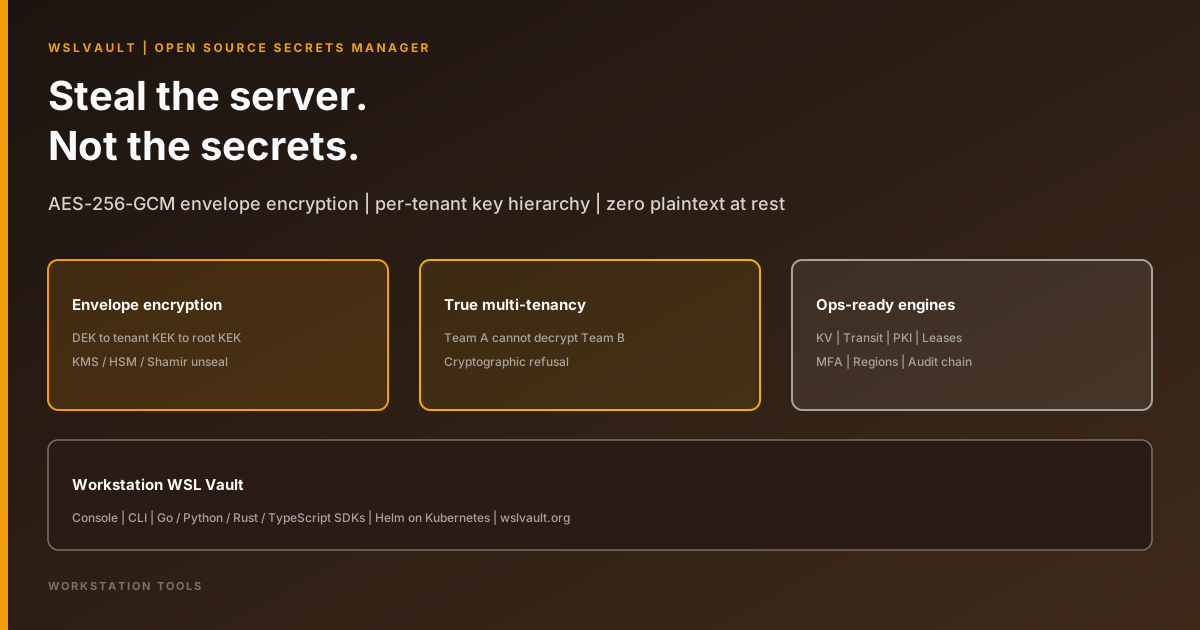
WSLVault — steal the server, not the secrets

20-minute intro — youtu.be/O6q3_H0k2M8

Thesis. Secrets management fails closed only when ciphertext at rest is worthless without key custody. WSLVault wraps every secret under a per-tenant hierarchy (DEK → tenant KEK → root KEK) so a stolen server, disk, or database dump does not equal stolen secrets.

1. Why this matters — steal the server

Classic failure mode: back up a database, lose a laptop, or compromise a host — and the attacker leaves with readable credentials. “Encryption at rest” that shares one key across every tenant, or that stores unwrapped material beside ciphertext, collapses under that scenario.

WSLVault’s design answer is simple to state and hard to fake: seal secrets before they touch disk, isolate tenants at the key layer, and keep root custody outside the data plane (KMS, HSM, or Shamir quorum).

2. What WSLVault is

WSLVault is an open-source, self-hosted secrets manager with Vault-compatible workflows:

  • Versioned KV secrets
  • Transit encryption (encrypt / decrypt / sign / verify)
  • PKI and short-lived certificates
  • Dynamic leases with real revoke
  • Identity, policies, and MFA
  • Active/active multi-region replication
  • Tamper-evident, hash-chained audit

Operators drive it from a web console, CLI, Go/Python/Rust/TypeScript SDKs, or MCP. Deploy with Helm/GitOps on Kubernetes. Product home: https://www.wslvault.org/.

3. Envelope encryption and key hierarchy
WSLVault envelope encryption hierarchy

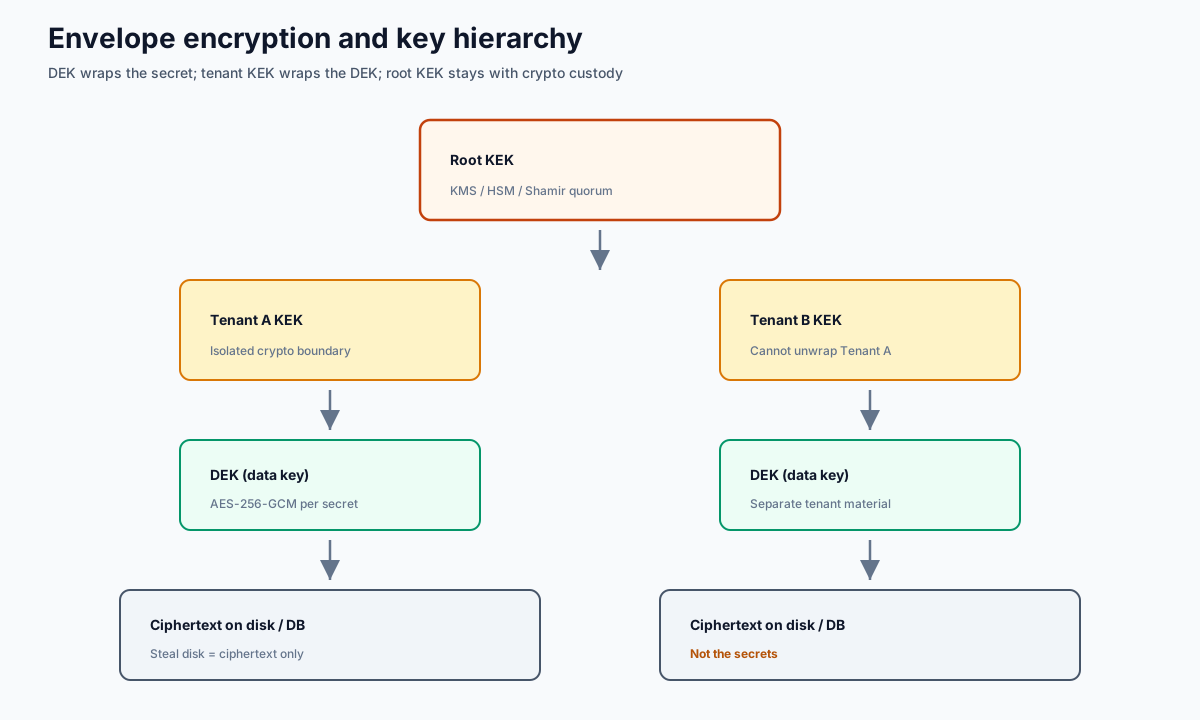
Each secret is sealed with a data encryption key (DEK). The DEK is wrapped under a tenant KEK. Tenant KEKs are wrapped under a root KEK held by the crypto service — typically backed by KMS, HSM, or Shamir-split custody so no single operator can unseal alone.

AES-256-GCM provides authenticated encryption. A database dump yields ciphertext wrapped under keys the database never sees. That is the practical meaning of steal the server, not the secrets.

4. Multi-tenancy that actually isolates

Application “tenant IDs” are not enough. In WSLVault, a data key belongs to exactly one tenant. A cross-tenant request returns “not found” rather than another tenant’s data. Isolation holds at the crypto service — Team A cannot decrypt Team B even if a bug in an upper layer misroutes an identifier.

That is cryptographic refusal, not an “oops” in a filter.

5. Console surfaces: secrets, transit, PKI

The steel/brass console walks the same engines as the API:

Engine What operators get
KV v2Versioned reads/writes, check-and-set, soft-delete/destroy, per-path metadata — sealed before storage
TransitEncrypt/decrypt/sign/verify without plaintext keys leaving the vault; rotate while old ciphertext stays readable
PKIPrivate CA, roles, short-lived certs; CA private keys envelope-encrypted under their own root

6. Identity, policies, leases, and MFA

Identity comes from a signed, per-tenant token — never a trusted header alone. Operators get self-service TOTP two-factor with recovery codes, fine-grained policies on API keys and JWTs, plus SCIM, LDAP, OIDC, mTLS, and cloud-workload auth patterns.

Dynamic credentials are leases: issued, listed, renewed, and revoked for real. Revoking a token stops it working immediately — not just flipping a row that something might ignore.

7. Regions, HA, and audit
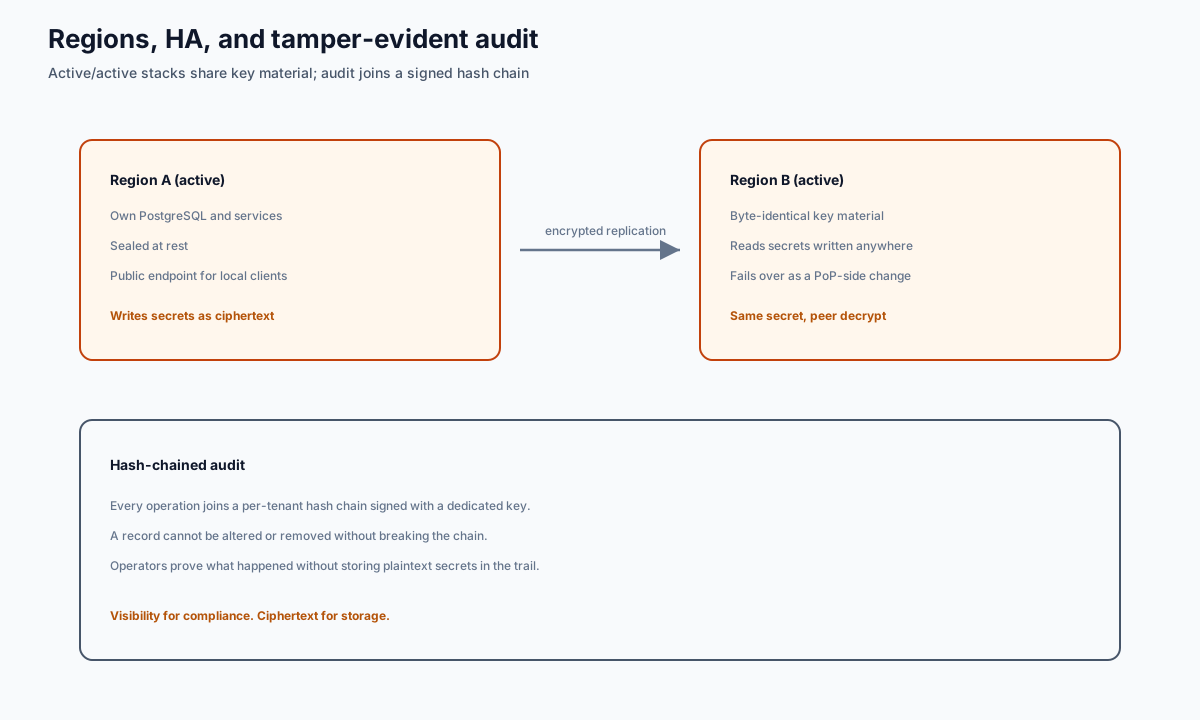
WSLVault multi-region replication and audit

Each region is a complete stack — its own database, services, and public hostname. Regions share key material, not a single live database. Replication moves encrypted changes so a peer can decrypt what was written elsewhere.

Every operation joins a per-tenant hash chain signed with a dedicated key. A record cannot be altered or removed without breaking the chain. That gives compliance visibility without storing plaintext secrets in the trail.

8. Deploy on Kubernetes

Ship with the Helm chart and Kubernetes operator, drive from GitOps, scrape with Prometheus, and reach the vault from SDKs or an AI agent over the built-in MCP server. Start from the official guide: GETTING-STARTED.md.

9. Video chapters

Time Topic
0:00Why this matters (steal the server)
1:30What WSLVault is
3:00Envelope encryption and key hierarchy
5:30Multi-tenancy that actually isolates
8:00Console walkthrough (secrets, transit, PKI)
11:00Identity, policies, leases and MFA
14:00Regions, HA and audit
17:00Deploy on Kubernetes
19:00Where to go next

10. Where to go next

  • Product: /en/wsl-vault
  • Site: wslvault.org
  • Repo: github.com/bwalia/wslvault
  • Docs: docs/
  • Related Workstation tools: WSL Proxy, Ring Promoter

Published by Workstation.
Diesen Artikel teilen

Mehr zu Technology

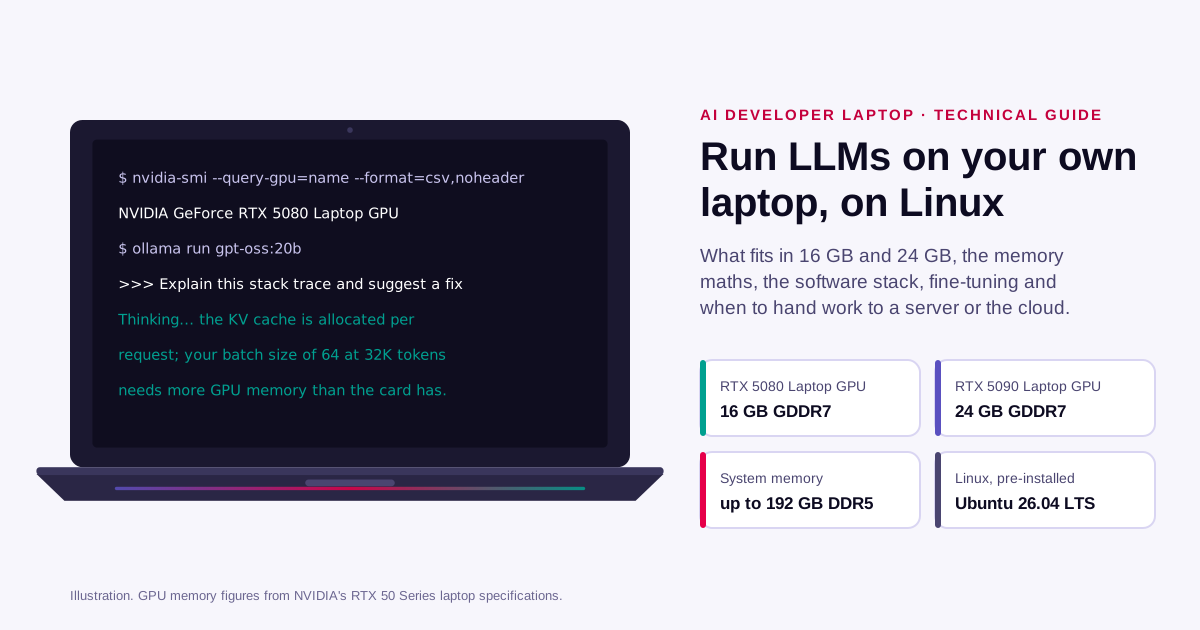
Laptops für KI-Entwickler: LLMs lokal unter Linux mit GPUs mit 16 GB und 24 GB betreiben (Leitfaden 2026)

Laptops für KI-Entwickler: LLMs lokal unter Linux mit GPUs mit 16 GB und 24 GB betreiben (Leitfaden 2026)

Was auf eine RTX 5080 oder RTX 5090 Laptop GPU passt, die Speicherrechnung, die lohnenden offenen Modelle, die Einrichtung von Ubuntu 26.04 mit dem NVIDIA-Stack, Ollama, llama.cpp und vLLM, Coding-Assistenten, LoRA-Fine-Tuning, Sicherheit und wann Arbeit auf einen Server gehört

Weiterlesen
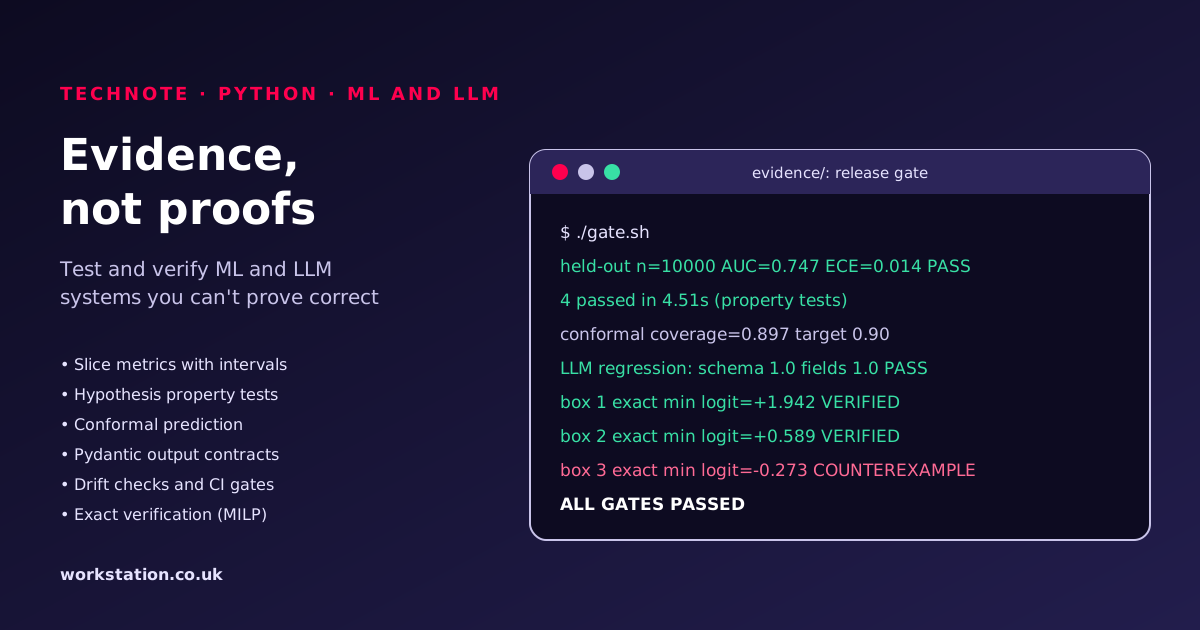
ML- und LLM-Systeme testen, deren Korrektheit sich nicht beweisen lässt: ein Python-Evidenz-Kit

ML- und LLM-Systeme testen, deren Korrektheit sich nicht beweisen lässt: ein Python-Evidenz-Kit

Evidenz statt Beweise, in etwa 400 Zeilen Python mit echter Ausgabe: Slice-Metriken mit Bootstrap-Intervallen und einem Pass/Fail-Vertrag, Property- und metamorphe Tests mit Hypothesis, Kalibrierung und Conformal Prediction, Pydantic-Verträge und Regressionsevaluierungen für LLM-Ausgaben, Drift-Prüfungen, ein CI-Gate und die exakte Verifikation eines kleinen neuronalen Netzes

Weiterlesen
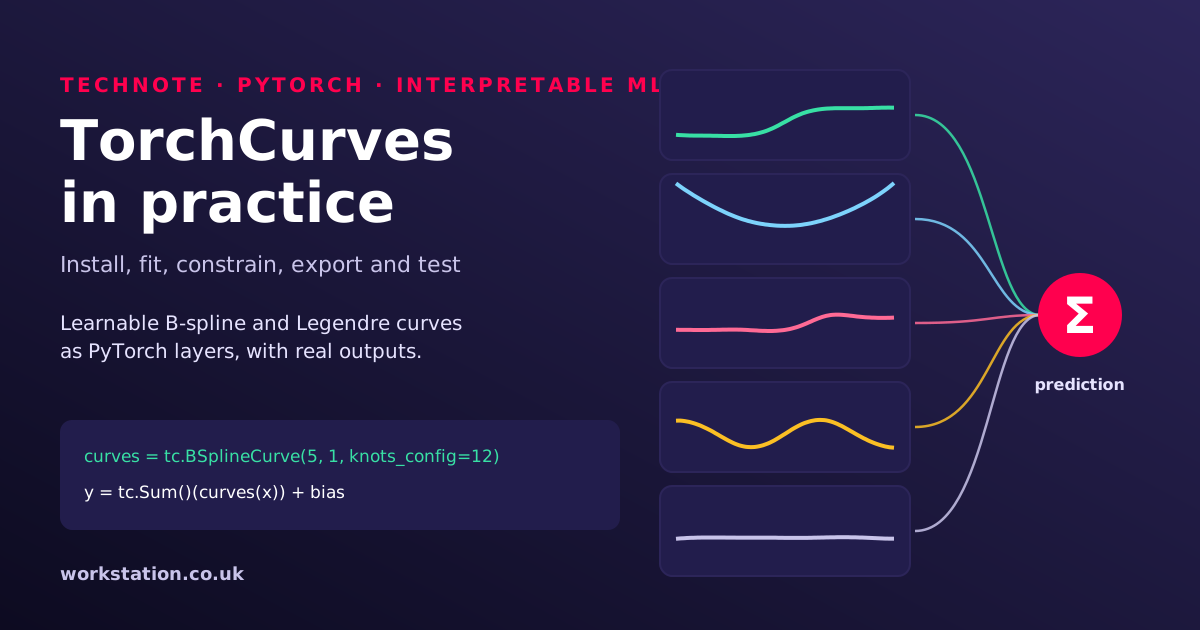
TorchCurves in der Praxis: lernbare B-Spline- und Legendre-Kurven in PyTorch

TorchCurves in der Praxis: lernbare B-Spline- und Legendre-Kurven in PyTorch

torchcurves installieren, eine Kurve anpassen und dimensionieren, B-Spline oder Legendre und die Eingabeabbildung wählen, eine monotone Kalibrierungskurve und ein additives Modell auf tabellarischen Daten bauen, mit SciPy, scikit-learn, einem KAN und einem MLP vergleichen, Koeffizienten nach JSON exportieren, testen und in der Produktion betreiben, mit echten Ausgaben

Weiterlesen