
Der Shop ist online

Wir bauen Workstation AI-Maschinen für Websites, KI-Agenten und LLM-Training – online konfigurieren und kaufen.

Händlerpreise erhalten
KI-Produkte
KI-LabsOpenAI-AgentenClaude-AgentenGrok-BotWorkstation AI-natives CRMMarketingAlle Produkte
KI-Lösungen
Angewandte KIKI-AgentenGenerative KIKI-AutomatisierungKI-WeiterbildungKI-Pakete für KMUEnterprise AI LabKI-WorkstationsNVIDIA-Hardware & -SoftwareNVIDIA Accelerated ComputingPrivate KIGPU-Private-CloudGPU-ClusterEdge-KIKI nach Branche
KI-Services
PlattformmodernisierungDigital EngineeringDatengrundlagen & KIAutonomer BetriebKI-BeratungDevOps-AutomatisierungCybersicherheitSoftwareentwicklungAgentenentwicklungMLOps-EinrichtungGPU-LeasingGPU-Private-Cloud
Über uns
UnternehmenUnsere GeschichtePartnerKundengeschichten
KI-Rechenzentren
KI-RechenzentrenGPU-Private-CloudGPU-ClusterGPU-Leasing
KI-EinblickeJev-ReiheBenchmark LabModellauswahl
Technische Hinweise
Dokumentation
Linux-BetriebssystemeUbuntuRed Hat Enterprise LinuxSUSE LinuxAlpine LinuxDebian, Rocky & AlmaLinux
KI-Cloud-PlattformenAWS & Amazon BedrockGoogle Cloud & Vertex AIMicrosoft Azure & AI FoundryGPU-Clouds & Marktplätze
Private KI-RechenzentrenFür AnwaltskanzleienFür Steuer- und WirtschaftsprüfungskanzleienOn-Premises-PlattformenVollständig abgesicherte Cloud
ToolsRing PromoterJobshout
News
Blog
KontaktAnmelden

KI-Workstations, Multi-Agenten-KI-Software, GPU-Infrastruktur und intelligente Agentenlösungen für moderne Unternehmen.

Kontakt

KI-Lösungen

Angewandte KIKI-AgentenGenerative KIKI-AutomatisierungKI-WeiterbildungKI-Pakete für KMUEnterprise AI LabKI nach Branche

Produkte

Alle ProdukteWorkstation AI-natives CRM & ERPMarketingOpenAI-AgentenRing PromoterJobshout

Unternehmen

Über unsUnternehmenKI-RechenzentrenWarum WorkstationPartnerKundengeschichtenPreiseKontaktTenthMatrix

Ressourcen

KI-EinblickeTechnische HinweiseDokumentationLinux-BetriebssystemeKI-Cloud-PlattformenPrivate KI-RechenzentrenBlogSucheSitemap
Büro Belgien
Workstation SRL, Rue Vanderkindere 34, 1180 Uccle, BrusselsBE 0751.518.683Mo – Fr: 9:00 – 18:00 Uhr MEZ
+32 492 45 67 46
Hauptsitz Großbritannien
77-79 Marlowes, Hemel Hempstead HP1 1LFAnfahrt – Ausfahrt 20 der M25 (Outer London)Handelsregisternr.: 11641870Mo – Fr: 9:00 – 18:00 Uhr GMT
+44 7515 356 146
Büro Indien
#159 Sector 9, Pocket 1, DDA Flats, 110077 Dwarka, New Delhi
+91 98881 98841
Büro Taiwan
3F, No. 2-4, Aisi Rd., Ren'ai Dist., Keelung City 200, Taiwan基隆市仁愛區愛四路2之4號3樓Mo – Fr: 9:00 – 18:00 Uhr Taiwan-Zeit (GMT+8)
+886 926 892 701+32 492 45 67 46
Büro Estland
Aleksander Puškini tn 30-25, 20306 Narva, EstoniaMo - Fr: 9:00 - 18:00 Uhr estnischer Zeit (EET)
+32 492 45 67 46

© 2026 Workstation AI. Alle Rechte vorbehalten.

DatenschutzDatenlöschungCookiesNutzungsbedingungenWebsite-Sitemap

NVIDIA, das NVIDIA-Logo, RTX, RTX PRO, Blackwell, CUDA, NVLink, MGX, Omniverse, Spectrum-X, Quantum, BlueField, DGX und HGX sind Marken und/oder eingetragene Marken der NVIDIA Corporation in den USA und anderen Ländern. AMD, das AMD-Arrow-Logo, EPYC, Instinct, Ryzen und Threadripper sind Marken von Advanced Micro Devices, Inc. Dell und PowerEdge sind Marken der Dell Inc. oder ihrer Tochtergesellschaften. Intel und Xeon sind Marken der Intel Corporation oder ihrer Tochtergesellschaften. AMAX, AceleMax und LiquidMax sind Marken der AMAX Engineering Corporation. Alle anderen Produktnamen, Logos und Marken sind Eigentum ihrer jeweiligen Inhaber. Wir verwenden sie ausschließlich, um die Produkte zu kennzeichnen, die wir beschreiben, liefern oder unterstützen; ihre Verwendung bedeutet nicht, dass ihre Inhaber uns empfehlen.

Loading blog...

Startseite / Blogs
AnthropicAILLMCodingFinOps

Claude Models Compared: Haiku vs Sonnet vs Opus vs Fable 5 (Mythos 5)

A quick guide to choosing the right Claude model tier, plus a cheap-to-frontier router.

Balinder Walia8. Juli 20263 min read
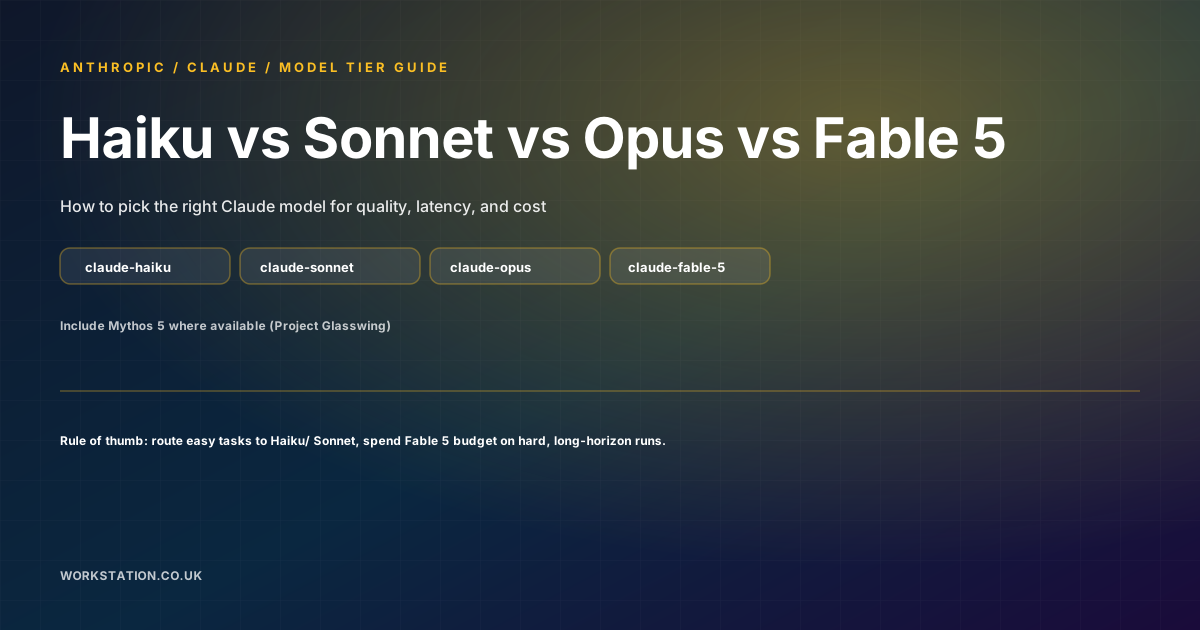
Claude models comparison cover: Haiku, Sonnet, Opus, Fable 5, Mythos 5

A quick, practical guide to Claude model tiers. For the full deep-dive with routing blueprints, prompting patterns, and a token-budget playbook, read the large article.

Claude models comparison: Haiku, Sonnet, Opus, Fable 5, Mythos 5

The one-paragraph version. Claude model selection is mostly a trade between latency, cost, and how long the task needs the model to stay in the flow. Use claude-haiku-4-5 for fast and cheap intent work, claude-sonnet-5 for the best speed/quality balance, claude-opus-4-8 for complex agentic coding and enterprise work, and reserve claude-fable-5 (and gated claude-mythos-5) for the truly hard, long-horizon jobs that take hours or days.

Model lineup at a glance

Model Best for Context window Max output Pricing (input / output) Thinking behavior
Claude Fable 5 (claude-fable-5) Long-running agents and hardest unsolved problems 1M tokens 128K tokens $10 / $50 per MTok Adaptive thinking always on
Claude Opus 4.8 (claude-opus-4-8) Complex agentic coding and enterprise work 1M tokens 128K tokens $5 / $25 per MTok Adaptive thinking always on
Claude Sonnet 5 (claude-sonnet-5) Best speed/quality balance 1M tokens 128K tokens $3 / $15 per MTok Adaptive thinking always on
Claude Haiku 4.5 (claude-haiku-4-5-20251001) Fastest model for cheap, high-volume tasks 200K tokens 64K tokens $1 / $5 per MTok Extended thinking available (adaptive off)

Claude Mythos 5 (claude-mythos-5) is a gated model that shares the same specs and pricing as Fable 5, but does not include the safety classifiers used by Fable 5. Availability is limited to approved partners via Project Glasswing.

Pick the right model (quick rules)

  • Haiku 4.5: routing, classification, extraction, and any workflow where you want fast replies and you cannot afford high output-token budgets.
  • Sonnet 5: daily coding and document work where you want strong quality without Opus/Fable pricing.
  • Opus 4.8: complex agentic coding, enterprise analysis, and harder debugging where longer, more autonomous work is required.
  • Fable 5: the hard, long-horizon problems that take hours or days, especially when the model must keep the goal, delegate sub-tasks, and stay coherent.

Effort and thinking: how it impacts cost

On the API, effort is the primary control for the trade-off between intelligence, latency, and cost on Fable 5 and Mythos 5. For Opus 4.8 and Sonnet 5, you can also set effort explicitly when you need a different cost/latency profile.

Practical implication: defaulting every request to maximum effort is usually the fastest way to spend your budget on output tokens.

Token strategy that works across all tiers

Claude output tokens are the expensive part. A simple rule is: cap output length, prompt for TLDR-first, and use prompt caching so stable prefixes (system instructions and tool schemas) are reused.

  • Use the cheapest model that can finish. A router (Haiku -> Sonnet/Opus -> Fable) often cuts cost dramatically while keeping quality high.
  • Set output limits. In production, always set a max output / token cap. Unbounded answers are a budgeting accident.
  • Use summaries strategically. Instead of sending full transcripts every turn, keep a compact “lessons” memory and only update it.

A simple router blueprint

  1. Classify intent and estimated complexity with claude-haiku-4-5.
  2. Send “normal hard” work to claude-sonnet-5 (or claude-opus-4-8 when you expect heavier agentic coding).
  3. Escalate to claude-fable-5 only when the task is clearly long-horizon or has failed on lower tiers.
  4. If Fable 5 refuses via safety classifiers, fall back to Opus 4.8 (the API supports refiring with fallbacks when configured).

Further reading (official)

  • Models overview
  • Introducing Fable 5 and Mythos 5
  • Prompting Claude Fable 5