Shop is live

We build Workstation AI machines for websites, AI agents, and LLM training — configure and buy online.

Get Trade Prices
AI Products
AI LabsOpenAI AgentsClaude AgentsGrok BotWorkstation AI native CRMMarketingAll Products
AI Solutions
Applied AIAI AgentsGenerative AIAI AutomationAI UpskillingAI SME PackagesEnterprise AI LabAI WorkstationsNVIDIA Hardware & SoftwareNVIDIA Accelerated ComputingPrivate AIGPU Private CloudGPU ClustersEdge AIAI by Industry
AI Services
Platform ModernisationDigital EngineeringData Foundations & AIAutonomous OperationsAI ConsultancyDevOps AutomationCyber SecuritySoftware DevelopmentAgent BuildingMLOps SetupGPU LeasingGPU Private Cloud
About Us
CompanyOur StoryPartnersCustomer Stories
AI Data Centres
AI Data CentresGPU Private CloudGPU ClustersGPU Leasing
AI InsightsJev seriesBenchmark LabModel selection
Technical Notes
Documentation
Linux OSUbuntuRed Hat Enterprise LinuxSUSE LinuxAlpine LinuxDebian, Rocky & AlmaLinux
AI Cloud PlatformsAWS & Amazon BedrockGoogle Cloud & Vertex AIMicrosoft Azure & AI FoundryGPU clouds & marketplaces
Private AI Data CentresFor law firmsFor accounting firmsOn-premises platformsFully secured cloud
ToolsRing PromoterJobshout
News
Blog
Contact UsSign in

AI workstations, AI Multi Agentic Software, GPU infrastructure, and intelligent agent solutions for modern businesses.

Contact Us

AI Solutions

Applied AIAI AgentsGenerative AIAI AutomationAI UpskillingAI SME PackagesEnterprise AI LabAI by Industry

Products

All ProductsWorkstation AI native CRM & ERPMarketingOpenAI AgentsRing PromoterJobshout

Company

About UsCompanyAI Data CentresWhy WorkstationPartnersCustomer StoriesPricingContactTenthMatrix

Resources

AI InsightsTechnical NotesDocumentationLinux OSAI Cloud PlatformsPrivate AI Data CentresBlogSearchSitemap
UK Head Office
77-79 Marlowes, Hemel Hempstead HP1 1LFDirections - Take Junction 20 off M25 Outer LondonCompany No: 11641870Mon - Fri: 9:00 AM - 6:00 PM GMT
+44 7515 356 146
Belgium Office
Workstation SRL, Rue Vanderkindere 34, 1180 Uccle, BrusselsBE 0751.518.683Mon - Fri: 9:00 AM - 6:00 PM CET
+32 492 45 67 46
India Office
#159 Sector 9, Pocket 1, DDA Flats, 110077 Dwarka, New Delhi
+91 98881 98841
Taiwan Office
3F, No. 2-4, Aisi Rd., Ren'ai Dist., Keelung City 200, Taiwan基隆市仁愛區愛四路2之4號3樓Mon - Fri: 9:00 AM - 6:00 PM Taiwan time (GMT+8)
+886 926 892 701+32 492 45 67 46
Estonia Office
Aleksander Puškini tn 30-25, 20306 Narva, EstoniaMon - Fri: 9:00 AM - 6:00 PM Estonia time (EET)
+32 492 45 67 46

© 2026 Workstation AI. All rights reserved.

PrivacyData DeletionCookiesTerms of ServiceWebsite Sitemap

NVIDIA, the NVIDIA logo, RTX, RTX PRO, Blackwell, CUDA, NVLink, MGX, Omniverse, Spectrum-X, Quantum, BlueField, DGX and HGX are trademarks and/or registered trademarks of NVIDIA Corporation in the US and other countries. AMD, the AMD Arrow logo, EPYC, Instinct, Ryzen and Threadripper are trademarks of Advanced Micro Devices, Inc. Dell and PowerEdge are trademarks of Dell Inc. or its subsidiaries. Intel and Xeon are trademarks of Intel Corporation or its subsidiaries. AMAX, AceleMax and LiquidMax are trademarks of AMAX Engineering Corporation. All other product names, logos and brands are the property of their respective owners. We use them only to identify the products we describe, supply or support; their use does not mean their owners endorse us.

Home / Technical Notes / Technology
DevOpsSecurityAISRE

WSLVault: Why AI Agents Need Cryptographic Secrets Isolation

Technical brief: why agentic systems raise the stakes for secret lifecycle, cosmetic tenant filters vs cryptographic refusal, envelope keys, leases, and video chapters

September 24, 2026Technology4 min read

Long-form companion to the blog. For platform and security architects shipping AI agents on shared infrastructure: why secret lifecycle is non-negotiable, and why isolation must be cryptographic — not a WHERE clause. Product: Workstation WSL Vault · wslvault.org · GitHub.
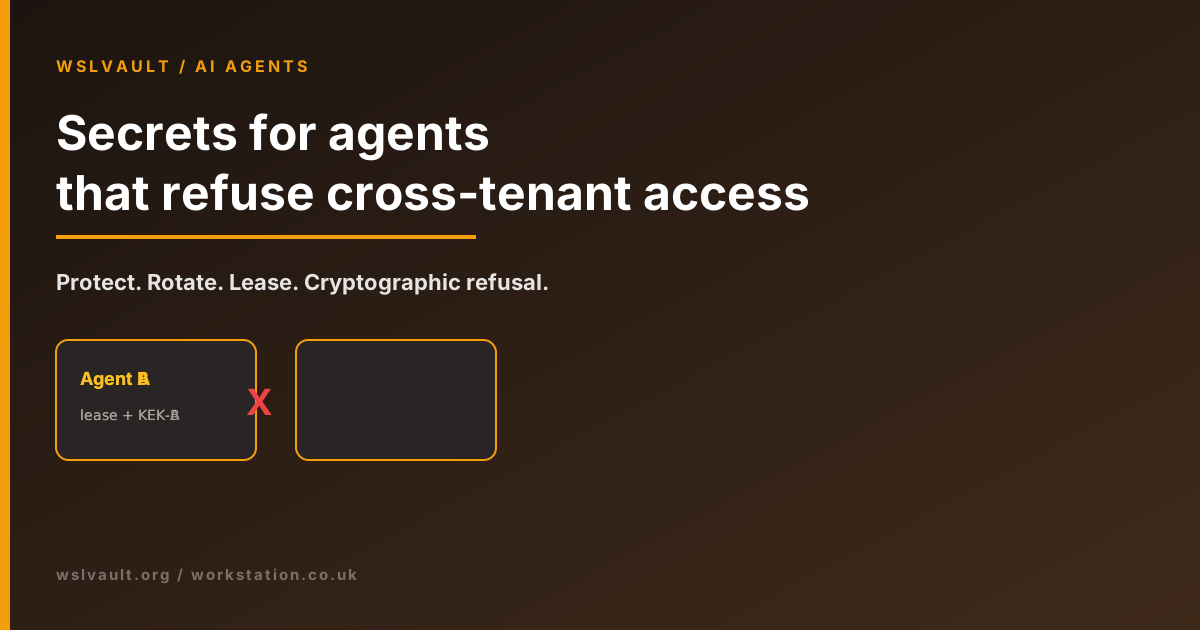
WSLVault — AI agents and cryptographic secrets isolation

~20 min — youtu.be/O6q3_H0k2M8 · same recording angled for tenancy

Thesis. AI agents amplify every secrets mistake: they call tools at machine speed, keep credentials across loops, and often share multi-tenant platforms. Protecting, rotating, and managing secrets is therefore more critical for agents than for classic services — and isolation that depends only on application filters is not isolation.

1. Why protecting, rotating, and managing secrets is even more critical for AI agents

Classic apps usually fetch a small set of credentials at startup. Agents are different:

  • Tool sprawl — one session may need cloud APIs, databases, ticketing, email, and MCP servers. Each credential is a live capability, not a config value.
  • Session persistence — keys sitting in env files, chat context, or MCP configs outlive a single request. Without rotation and leases, compromise windows stay open.
  • Autonomous action — once an agent holds a token, it will use it. There is no “wait for the human to notice” between leak and abuse.
  • Multi-tenant agent platforms — Team A’s agent and Team B’s agent may share schedulers, storage, and observability. A bug or a stolen database dump must never hand one tenant the other’s plaintext.
  • Compliance and audit — regulators and customers ask who accessed which secret, for which agent, and whether the trail can be tampered with.

That is why the control set for agents is stricter: protect (envelope encryption at rest), rotate (KEK/DEK and static roles on a period), and manage (identity-bound policies, short-lived leases, real revoke).

Agent digest. (1) Never put long-lived secrets in agent prompts or MCP config files. (2) Issue dynamic credentials with TTL; renew near expiry; revoke on stop. (3) Bind identity per tenant and per agent workload. (4) Assume shared infrastructure — require cryptographic tenant isolation, not cosmetic tenant IDs.

2. Why tenant IDs alone are cosmetic isolation

Most “multi-tenant vaults” isolate with application filters: WHERE tenant_id = ?. That fails closed only if every code path is perfect forever — including backups, analytics jobs, support tools, and the next junior PR.

When Team A and Team B share a platform, ask: can a bug or a stolen database dump ever hand one team the other’s plaintext? If the answer depends on a filter, the answer is yes.
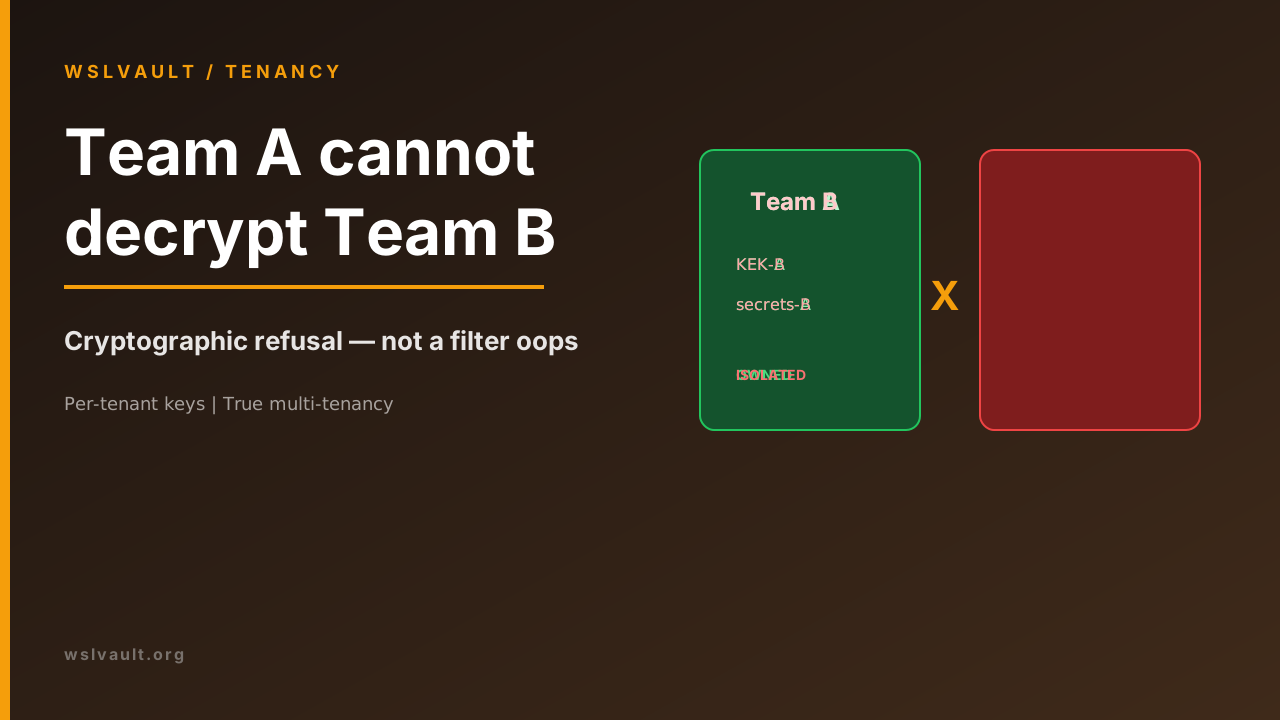
Team A cannot decrypt Team B

3. Cryptographic refusal — WSLVault’s answer

WSLVault seals every secret before storage under a per-tenant hierarchy: DEK → tenant KEK → root KEK (KMS / HSM / Shamir). Each data key belongs to exactly one tenant. A cross-tenant request returns not found, not another tenant’s row with the wrong label.

That is cryptographic refusal: Team A cannot decrypt Team B even if an upper layer misroutes an identifier. Isolation holds at the crypto service — the place filter bugs cannot quietly rewrite.
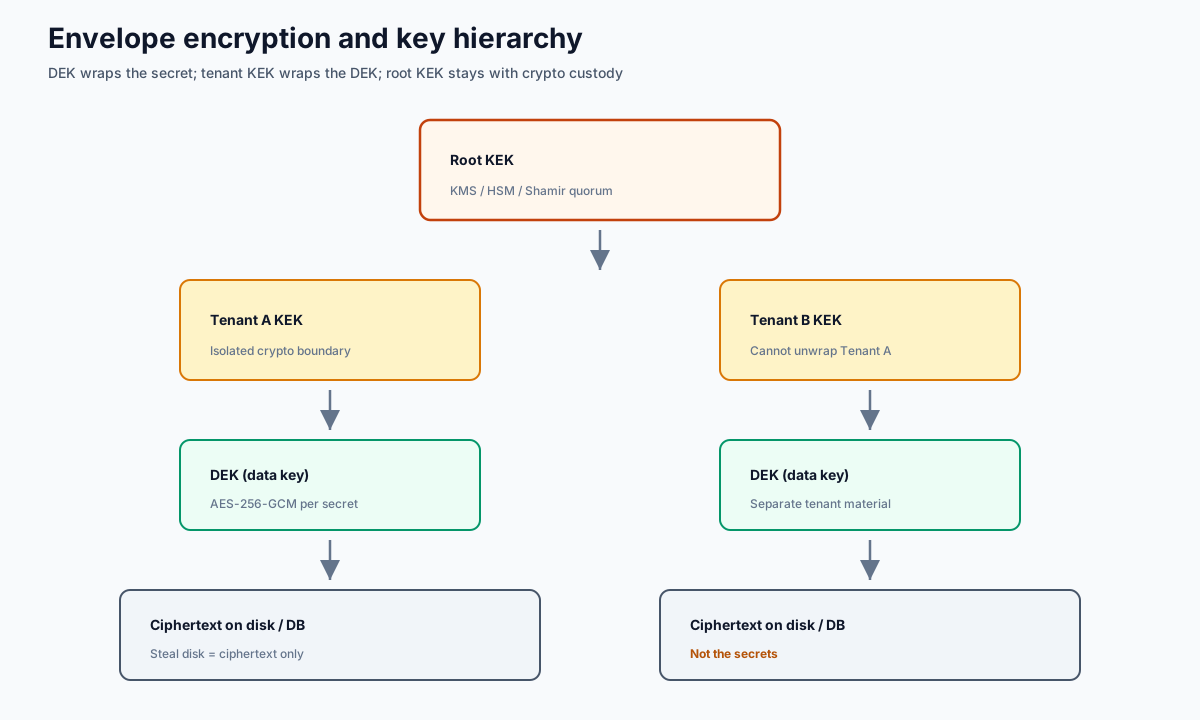
WSLVault envelope encryption key hierarchy

4. Engines still work per tenant

Isolation does not mean you lose Vault-compatible workflows. Per tenant you still get:

Engine Why agents care
KV v2Versioned config and API material sealed before disk — not plaintext beside the agent runtime
TransitEncrypt/decrypt/sign without exporting keys into the model or tool process
PKIShort-lived certs for mTLS between agent, MCP, and backends
LeasesDynamic credentials with renew/revoke — stop the agent, kill the access

5. Protect → rotate → manage (agent checklist)

  1. Protect — envelope encryption; root custody outside the data plane; no plaintext in backups or audit payloads.
  2. Rotate — rotate tenant KEKs and static roles on a period; keep old ciphertext readable via transit versioning where needed.
  3. Manage — identity-bound tokens (not trusted headers alone), fine-grained policies, MFA for operators, leases with real revoke for agent sessions.
  4. Prove — tamper-evident, hash-chained audit per tenant so you can show who did what without storing secrets in the trail.
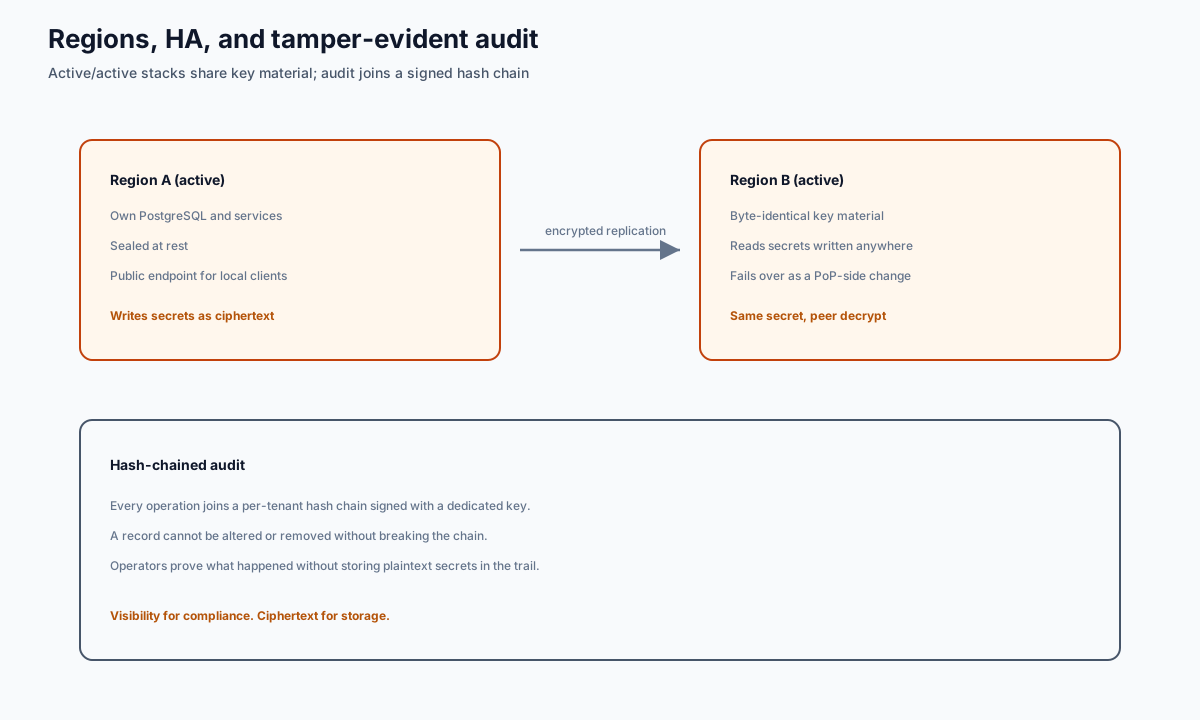
WSLVault multi-region and tamper-evident audit

6. Video chapters

Time Topic
0:00Why this matters (steal the server)
1:30What WSLVault is
3:00Envelope encryption and key hierarchy
5:30Multi-tenancy that actually isolates
8:00Console walkthrough (secrets, transit, PKI)
11:00Identity, policies, leases and MFA
14:00Regions, HA and audit
17:00Deploy on Kubernetes
19:00Where to go next

7. Where to go next

  • Site: https://www.wslvault.org/
  • GitHub: https://github.com/bwalia/wslvault
  • Getting started: GETTING-STARTED.md
  • Workstation product page: /en/wsl-vault
  • Intro brief: Steal the server. Not the secrets.
  • Related: Agentic AI security — MCP, OAuth, Vault leases

Published by Workstation.
Share this article

More in Technology

AI Developer Laptops: Running LLMs Locally on Linux with 16 GB and 24 GB GPUs (2026 Guide)

AI Developer Laptops: Running LLMs Locally on Linux with 16 GB and 24 GB GPUs (2026 Guide)

What fits on an RTX 5080 or RTX 5090 Laptop GPU, the memory arithmetic, the open models worth running, Ubuntu 26.04 setup with the NVIDIA stack, Ollama, llama.cpp and vLLM, coding assistants, LoRA fine-tuning, security, and when to move work to a server

Read more
Testing ML and LLM Systems You Can't Prove Correct: A Python Evidence Kit

Testing ML and LLM Systems You Can't Prove Correct: A Python Evidence Kit

Evidence instead of proofs, in about 400 lines of Python with real output: slice metrics with bootstrap intervals and a pass/fail contract, Hypothesis property and metamorphic tests, calibration and conformal prediction, Pydantic contracts and regression evals for LLM output, drift checks, a CI gate, and exact verification of a small neural network

Read more
TorchCurves in Practice: Learnable B-spline and Legendre Curves in PyTorch

TorchCurves in Practice: Learnable B-spline and Legendre Curves in PyTorch

Install torchcurves, fit and size a curve, choose B-spline or Legendre and the input map, build a monotone calibration curve and an additive model on tabular data, compare with SciPy, scikit-learn, a KAN and an MLP, export coefficients to JSON, test and run it in production, with real outputs

Read more